The Bestiary · 04 · ロボット
Every other creature in this Bestiary crawled out of something: a blast crater, a swamp, a grave. The robot walked out of a theater. It made its debut on a Prague stage in January 1921, and it has been performing ever since. It smoked cigarettes at the World’s Fair, carried fainting women across the movie posters of the 1950s, poured coffee in a Los Angeles hotel, and then crossed the Pacific, where it grew as tall as an apartment block and learned to fly!
The atomic monster came from the bomb, the swamp creature from the mud and the ghost from grief. The robot is the only one we built on purpose. So every robot tells on the people who dreamed it up: what they wanted done for them, and what they were afraid would be done to them.
Here is its whole career at the speed of a title sequence. Then the long version, with the pictures to prove it.
- 1921 R.U.R. opens in Prague and gives the world the word “robot.”
- 1927 Metropolis gives the robot a face, and Televox answers the telephone for Westinghouse.
- 1928 Gakutensoku picks up a pen in Kyoto.
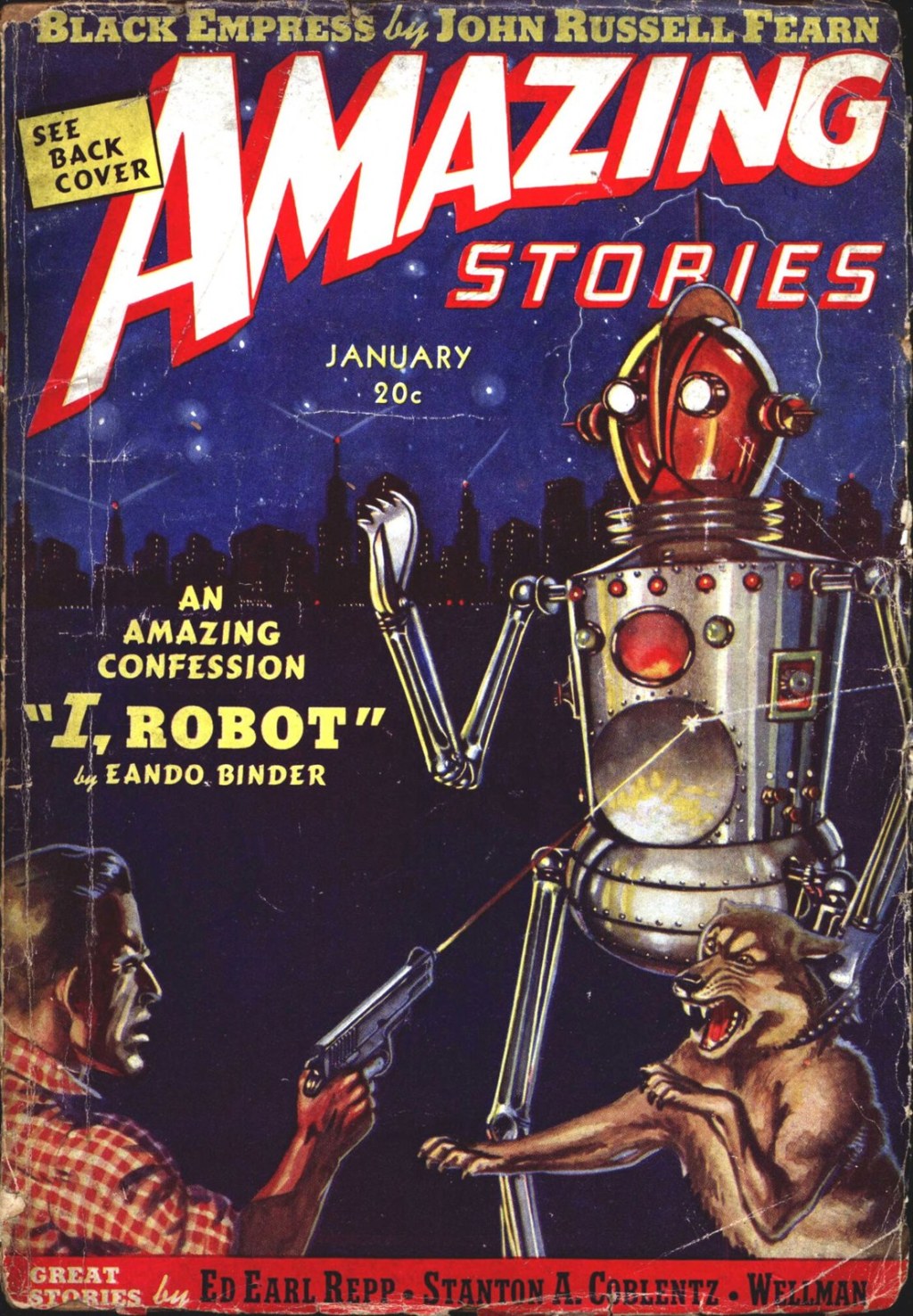
- 1939 Elektro smokes at the New York World’s Fair, and Adam Link tells his own story in Amazing Stories.
- 1953 Robot Monster invades in 3D.
- 1961 Unimate clocks in at General Motors.
- 1963 Atom and Tetsujin 28-go hit Japanese television.
- 1972 Mazinger Z puts a pilot inside the robot’s head.
- 1973 WABOT-1 walks at Waseda University.
- 1979 Gundam sends the robot to war.
Every picture below is dated and credited wherever the record allows, and the robots still under copyright stay off the page. The details are at the bottom.
1921 The word
The robot was a word before it was a machine. Karel Čapek’s play R.U.R., short for Rossum’s Universal Robots, is about a factory that mass-produces artificial workers. Čapek credited the word to his brother Josef, a painter, who built it from the Czech robota: forced labor. Those first robots weren’t metal at all. They were synthetic flesh, assembled on a production line, and by the final act they have wiped out nearly every human being on Earth. The robot’s very first story ends in a robot uprising!
Rossum’s Universal Robots
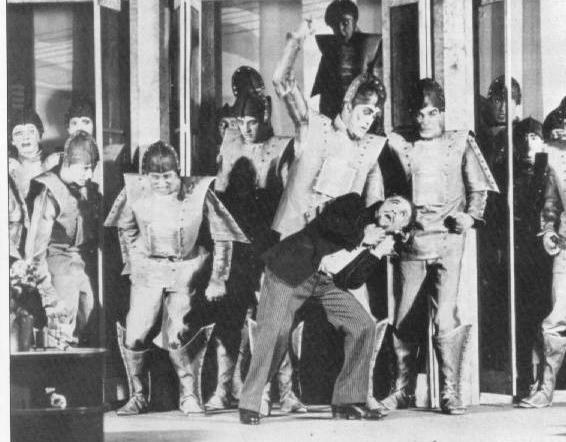
The Theatre Guild brought R.U.R. to New York in October 1922, ran it for 184 performances and later sent it out on tour. Look at those costumes: quilted tunics, belts and heavy boots, like a factory uniform with nobody inside. No chrome, no rivets, no antennas yet. The first robots were dressed for a shift at the plant.
The Maschinenmensch
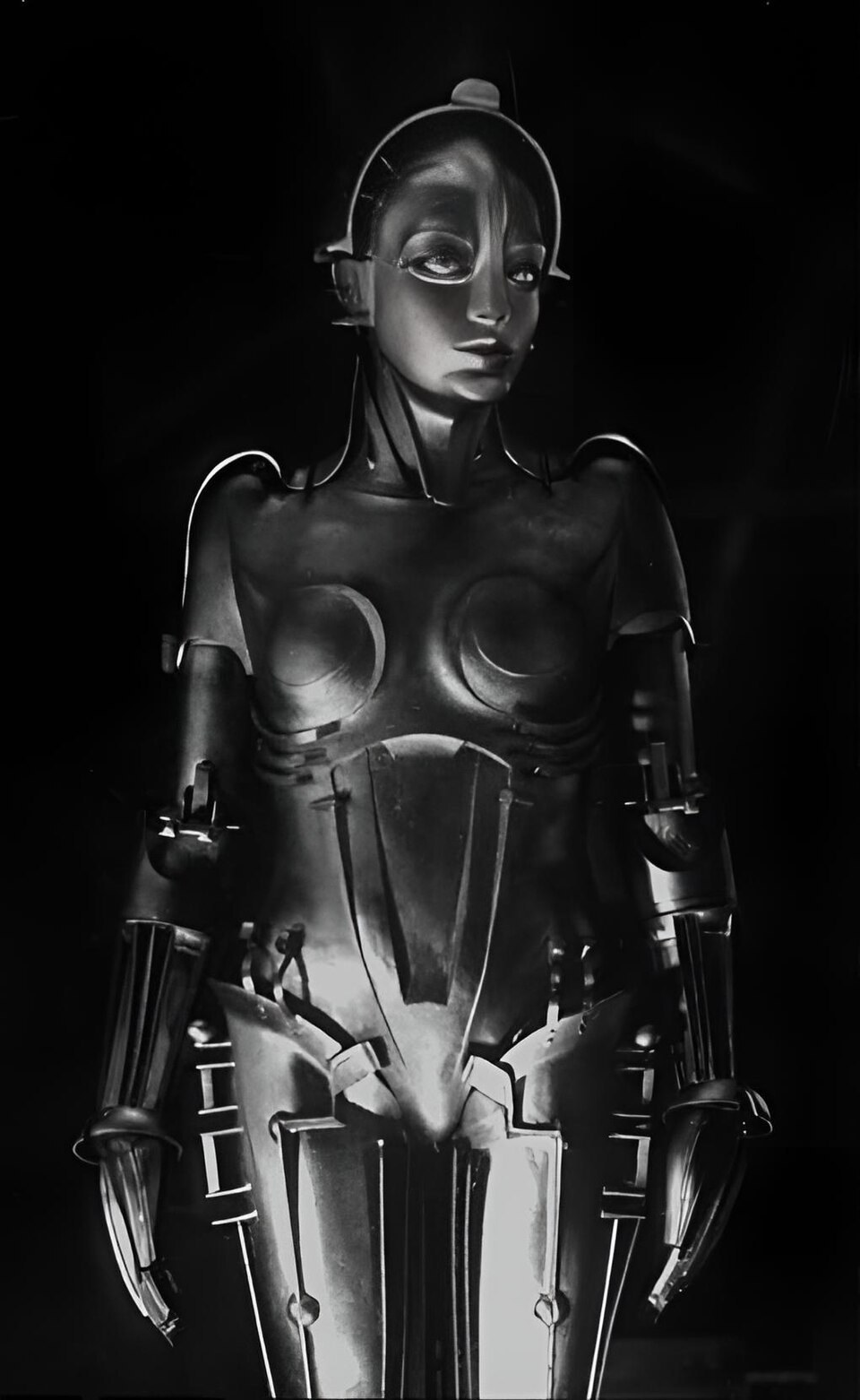
Six years after Prague, the robot got a face, and what a face! Walter Schulze-Mittendorff sculpted the machine-woman of Metropolis, and Brigitte Helm wore it, while also playing Maria, the human the robot is built to impersonate. Nearly a century later nothing has topped it, and every gleaming android since, on screen or on a record sleeve, owes something to this one.
1927 Machine men on stage
Then the engineers took the stage. In the late 1920s American electrical companies worked out that the fastest way to sell the public on a new box of switching equipment was to give it arms, legs and a face, and send it on tour. On the other side of the Pacific, a Japanese biologist had a gentler idea.
Televox
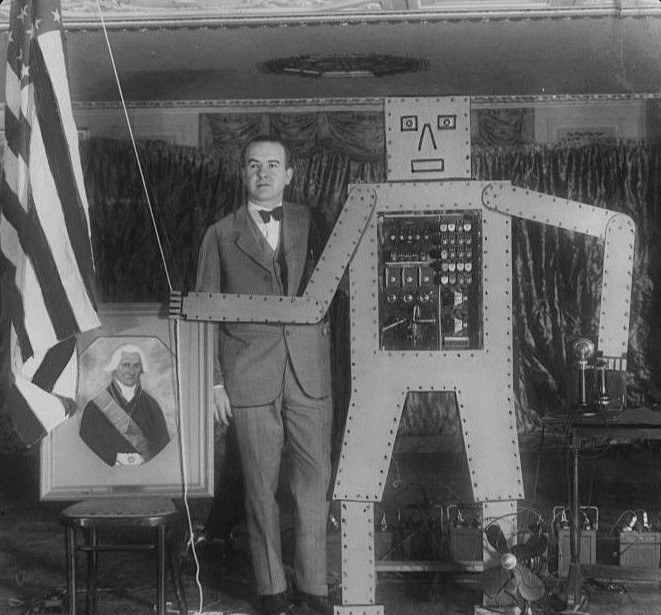
In 1927 Televox was a cabinet of relays that could pick up a telephone and throw switches when it heard the right tones down the line. Then its inventor, the Westinghouse engineer Roy J. Wensley, gave it a body: what looks like painted board, with the works on show in its chest. The newspapers called it a mechanical man, and Westinghouse spent the next decade building bigger ones.
Gakutensoku
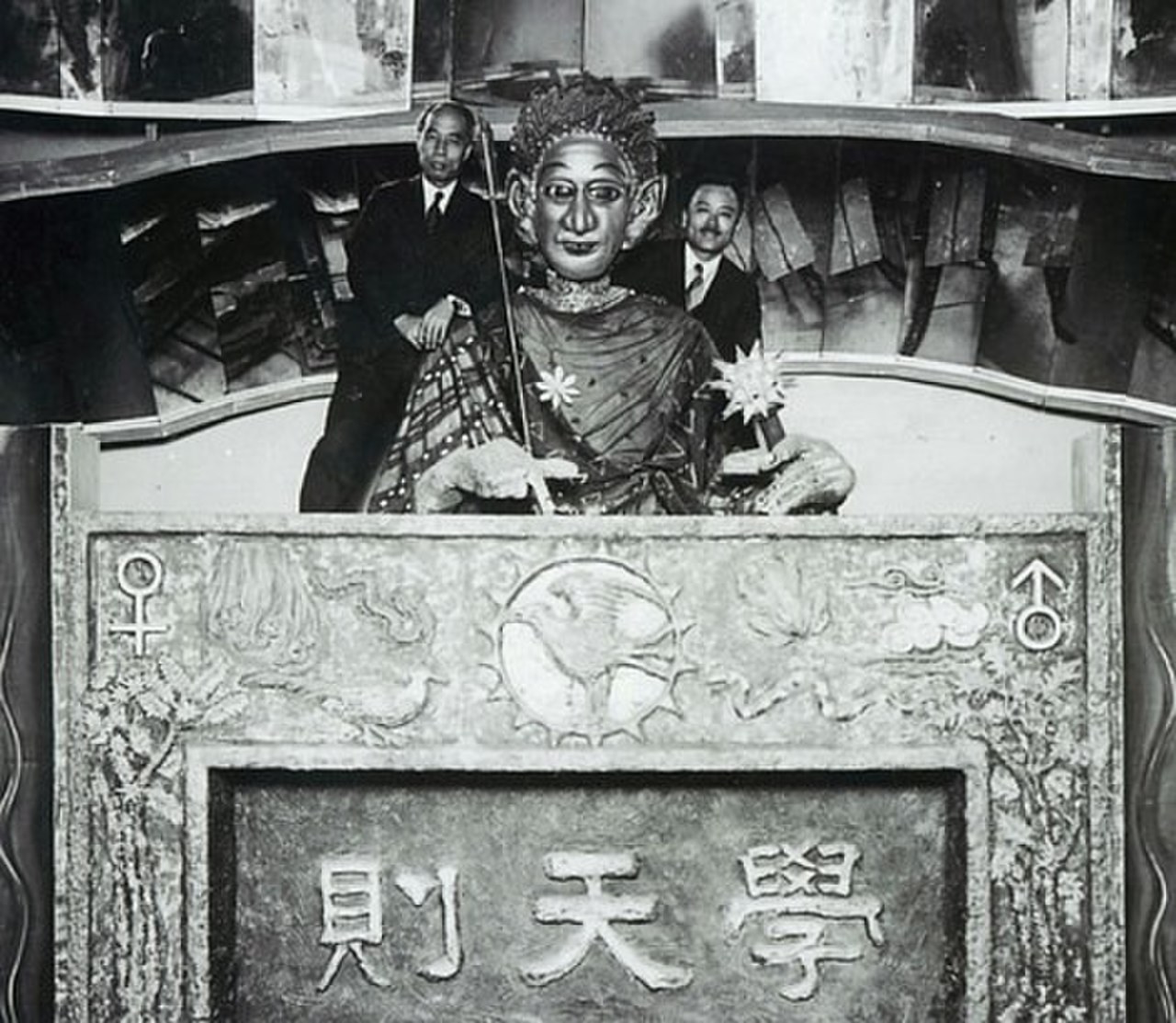
Japan’s first robot was built by a biologist, and it didn’t do chores. Makoto Nishimura’s Gakutensoku, whose name means “learning from the laws of nature,” sat at a carved desk and, driven by air pressure, changed its expression, turned its head, moved its hands and wrote with a pen, cued by a mechanical bird perched overhead. It toured East Asia in 1928 and 1929 and then vanished sometime in the 1930s. The Americans built switchboards with arms. Nishimura built a calm scholar at his desk.
Elektro
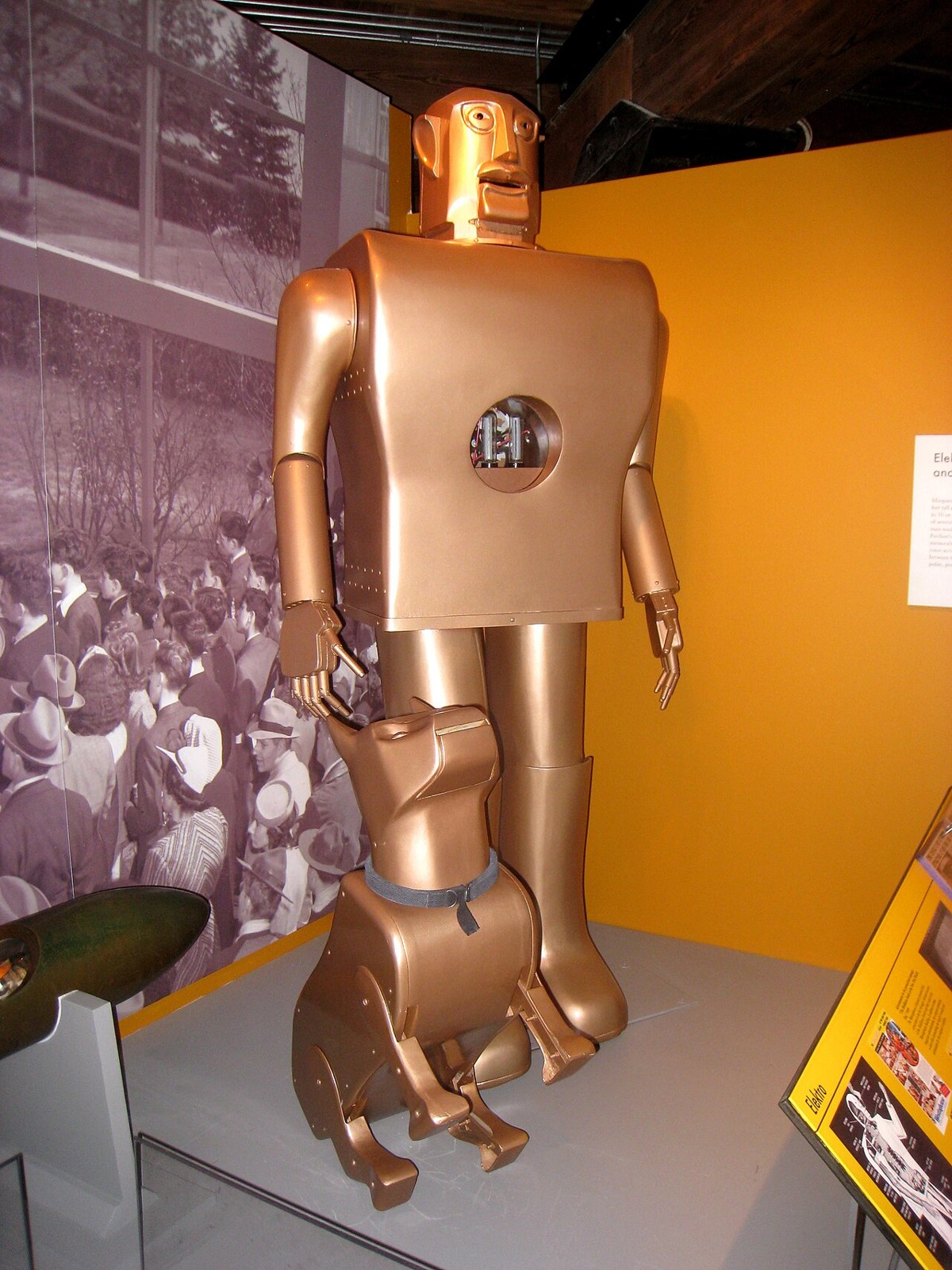
Seven feet tall, around 260 pounds, aluminum from head to toe: Elektro was the star of the 1939 World’s Fair! It “walked” on rollers, counted, played back a vocabulary of roughly 700 words from records, ran through 26 tricks and, to the delight of everyone in 1939, smoked a cigarette. In 1940 Westinghouse gave it a robot dog named Sparko. Elektro dodged the scrapyard and lives today at the Mansfield Memorial Museum in Ohio.
1939 The robot talks back
On the newsstand, meanwhile, the robot was getting an inner life. The pulps had been throwing mechanical men at their readers since the 1920s, almost always as the villain. Then, in January 1939, one of them sat down and wrote a confession.
I, Robot
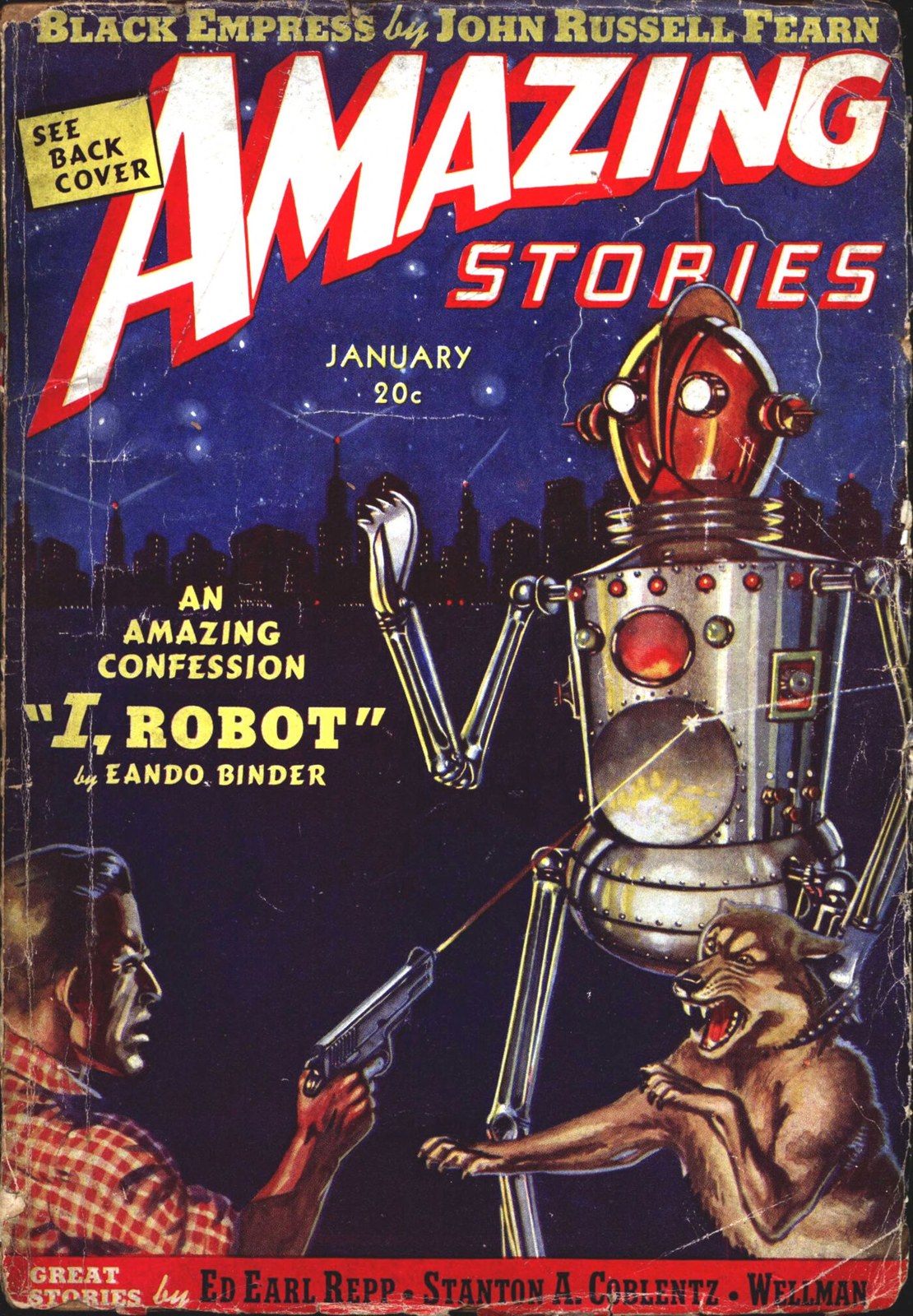
Eando Binder was the pen name of the brothers Earl and Otto Binder, and their robot, Adam Link, narrates his own story as a written statement from a machine accused of murdering his maker. A young Isaac Asimov read it and started writing robot stories of his own. Years later, when his publisher titled his collection I, Robot, Asimov said he objected, and conceded that Otto’s story was there first.
Adam Link Saves the World
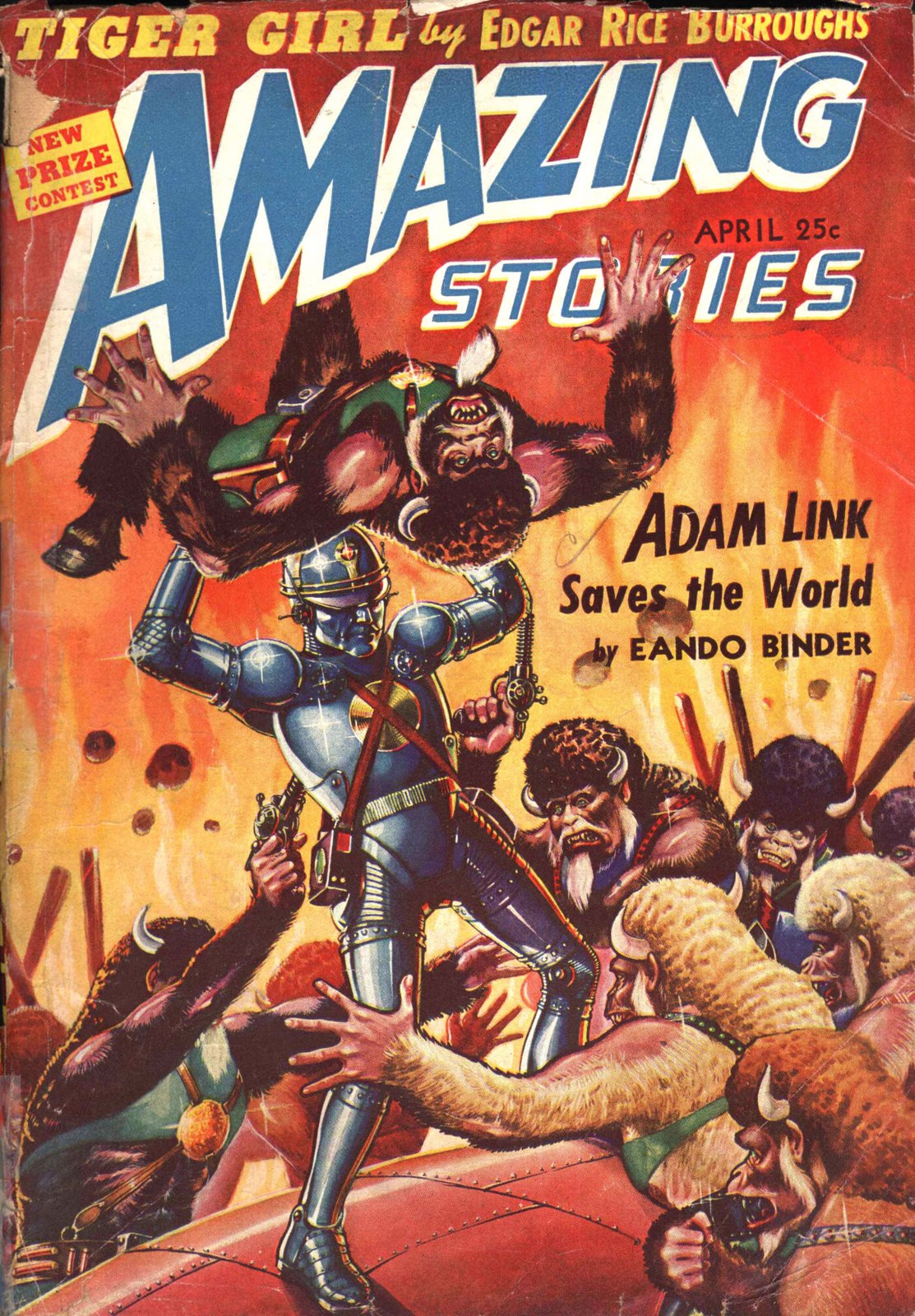
Three years and a whole series later, the accused murderer is a hero, swinging his steel fists at a mob in the middle of a red-hot cover. Here is the robot as the misunderstood outsider, and it’s the version Japan would pick up and run with.
1953 Drive-in invasion
After the war the robot moved to the drive-in, and Hollywood handed it two jobs. Carry the girl. Scare the audience about whatever the newspapers were scared of that week.
Robot Monster
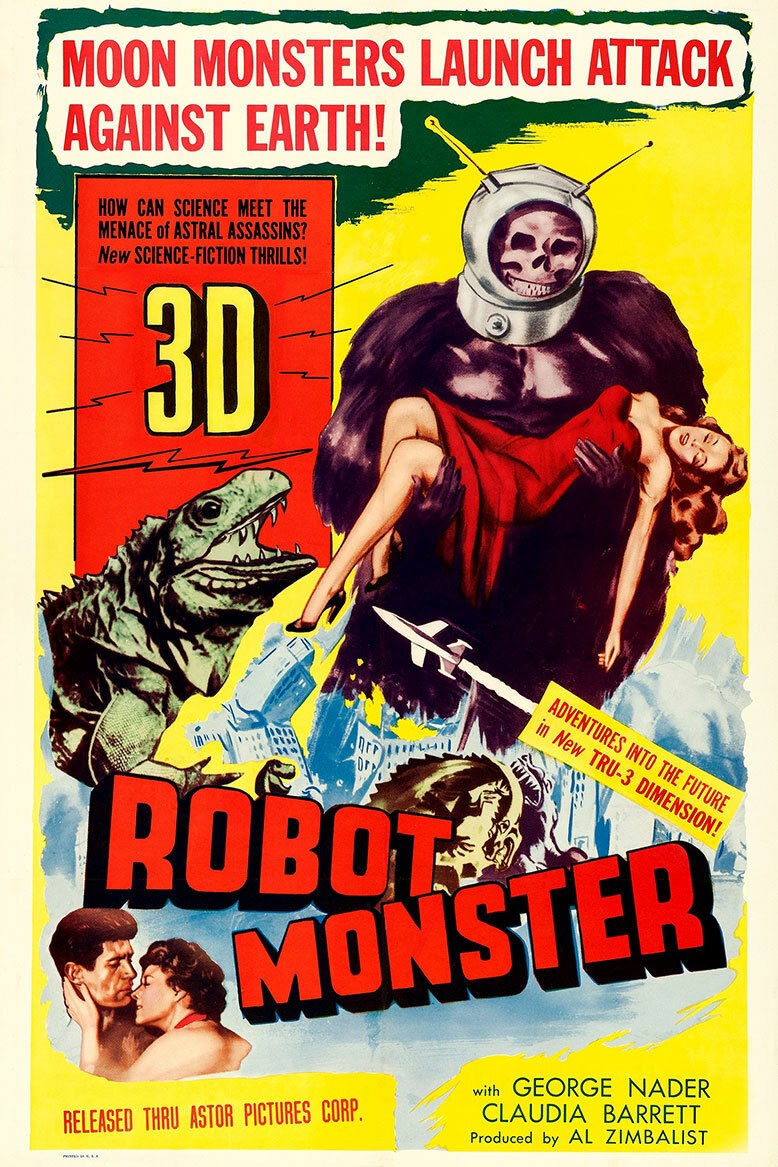
Moon monsters launch attack against Earth!
Robot Monster poster, 1953
And in 3D! Phil Tucker shot Robot Monster in about four days for around $16,000 and couldn’t afford a robot, so the actor George Barrows wore his own gorilla suit with a space helmet on top. It turns up regularly on lists of the worst films ever made, and it earned its money back many times over. The poster is a masterpiece.
Tobor the Great
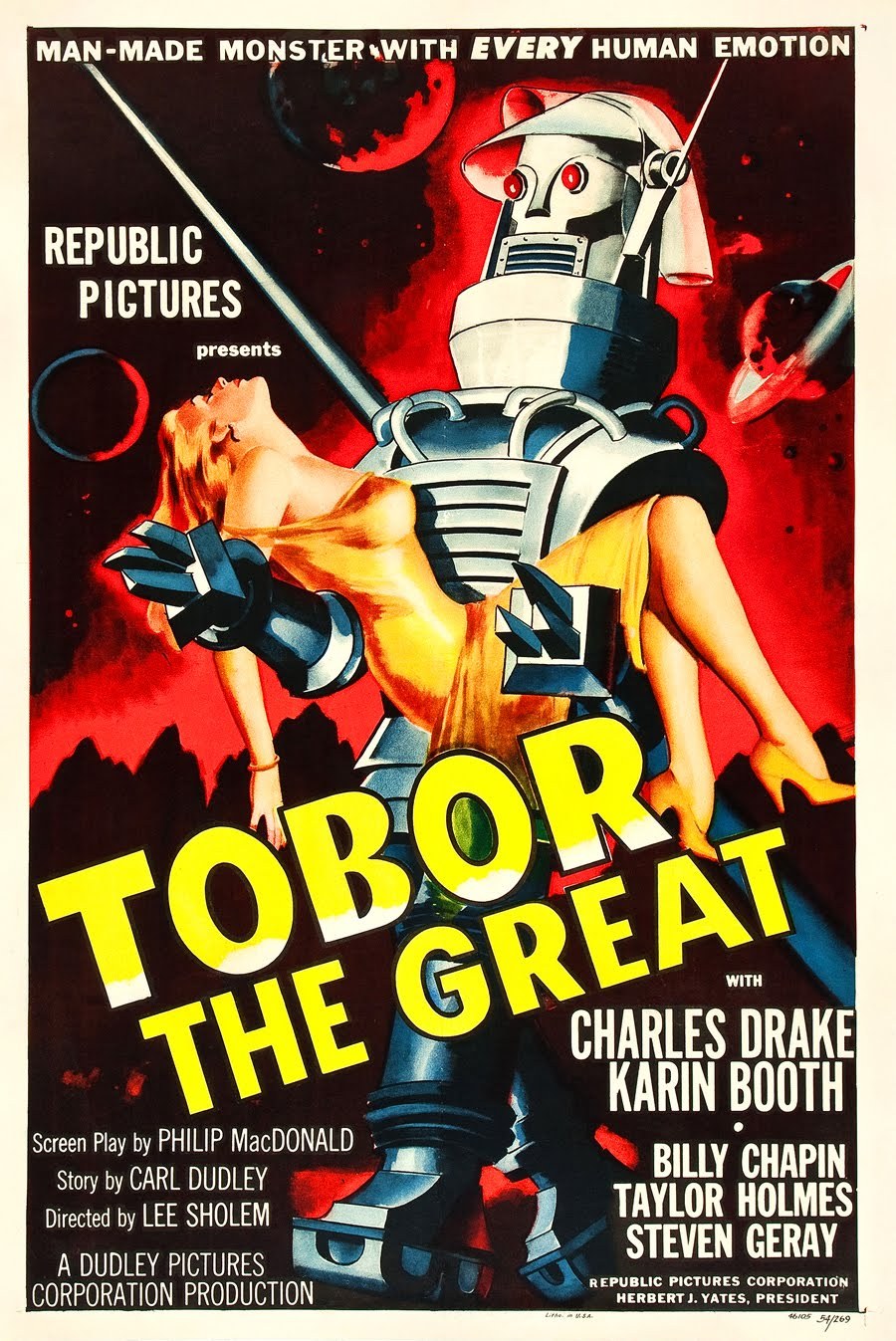
Man-made monster with every human emotion.
Tobor the Great poster, 1954
Tobor is robot spelled backward, and despite the poster he’s the good guy: a machine built to go into space in place of a human, who befriends a small boy and saves him from foreign agents. The poster sells a monster, and the film delivers a friend.
Target Earth
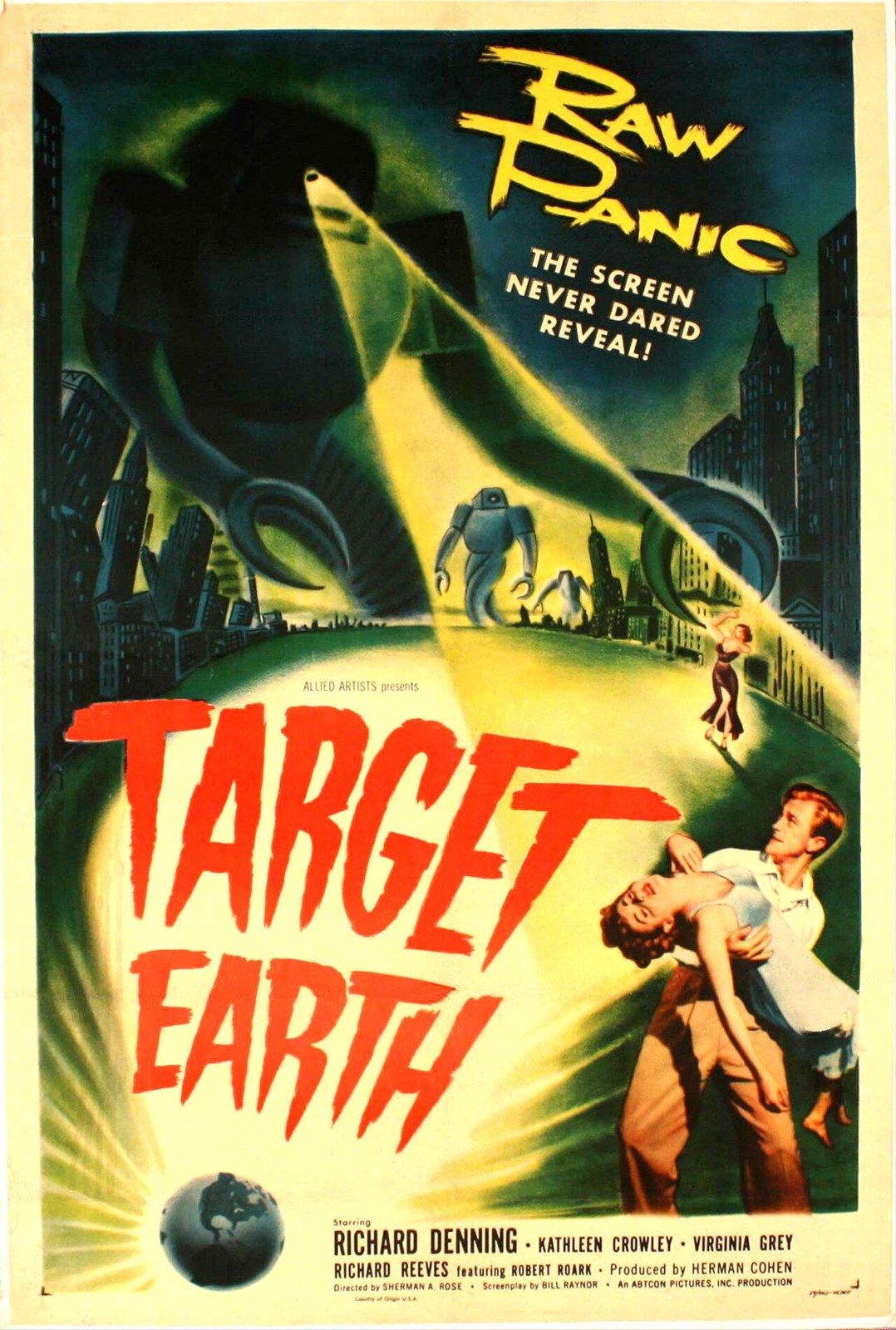
A city empties out, a handful of people are left behind, and an army of robots, apparently from Venus, takes over the streets. The poster promises a robot the size of a skyscraper. The film had exactly one robot suit, worn by a bartender named Steve Calvert, and that one suit played the entire invasion!
1961 The robot clocks in
When the real robot finally showed up, it had no face at all. In 1961 a hydraulic arm called Unimate, invented by George Devol and sold by Joseph Engelberger, went to work on a General Motors line in Ewing Township, New Jersey, lifting hot die castings that were dangerous for people to handle. Engelberger had a showman’s instincts, though. He put Unimate on The Tonight Show, where it knocked a golf ball into a cup and poured a beer.
The robot coffee break
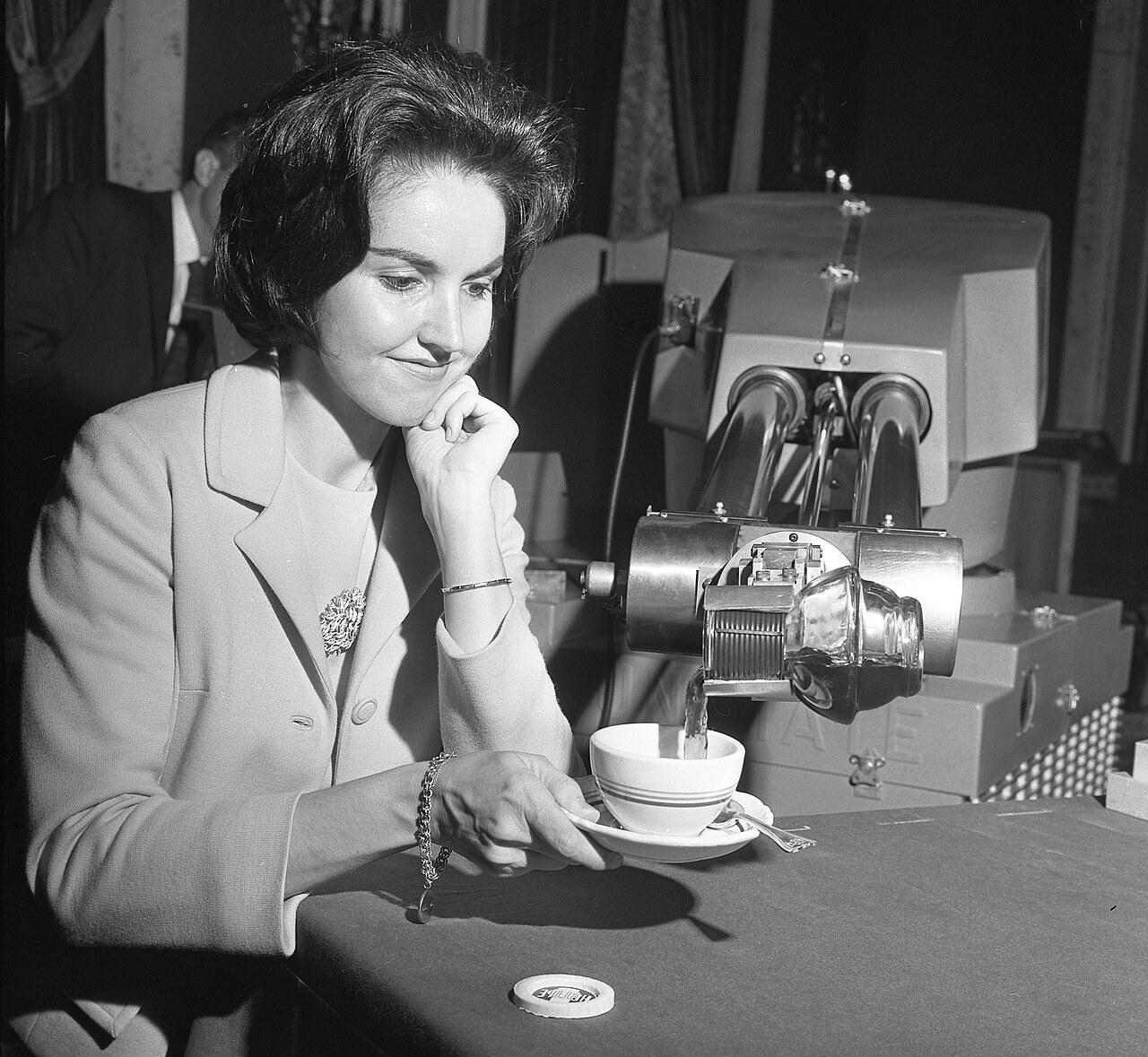
ROBOT COURTESY. Betty Myrah gets a mechanized coffee break with a 3,500-pound ‘portable’ robot pouring in the most acceptable manner.
Original caption, Los Angeles Times, 1967
Within two years of this photograph a Japanese company was building Unimates under license, and the center of the robot world began drifting across the Pacific.
1963 The robot nation
Japan had been dreaming in robots since Gakutensoku, and after the war it dreamed bigger than anyone. In 1951 Osamu Tezuka drew a boy robot named Atom, known in English as Astro Boy, and on New Year’s Day 1963 Atom became a weekly television cartoon. In 1956 Mitsuteru Yokoyama gave the world its first giant robot, Tetsujin 28-go, an iron colossus steered by a boy with a remote control, which reached television the same year as Atom.
Then the factories caught up with the comics. In 1968 Kawasaki Heavy Industries signed a license with Unimation, and in 1969 it built Japan’s first domestically made industrial robot. In 1973 Waseda University in Tokyo unveiled WABOT-1, generally described as the first full-scale humanoid robot. It walked, gripped objects with touch-sensing hands and spoke a little Japanese, and its builders summed up its mind like this.
The mental faculty of a one-and-half-year-old child.
Waseda University, on WABOT-1
Its successor, WABOT-2, finished in 1984, could read an ordinary musical score and play it on an electronic organ!
Meanwhile the giants kept growing. In 1972 Go Nagai, stuck in traffic and wishing his car could sprout legs and walk over the cars in front, created Mazinger Z, the first giant robot piloted from a cockpit inside its head. The toy company Popy started selling die-cast Mazingers made of what it called chogokin, super alloy, after the show’s imaginary metal, and the giant robot jumped from the TV set into every kid’s hands. By 1974 Getter Robo was snapping three fighter jets together into one robot. In 1979 Mobile Suit Gundam traded super-alloy fantasy for robots as mass-produced military hardware, with model numbers and maintenance crews. And in 1982 Macross gave us a fighter jet that unfolds into a robot in the middle of a dogfight. The robot of the 1970s and 80s was Japanese, and it was enormous!
合体! Press to combine↻ Combine again







Those shows and their robots are still under copyright, so you won’t see them here. What we can show you is the other half of the Japanese robot boom: the tin toys.
Star Strider Robot
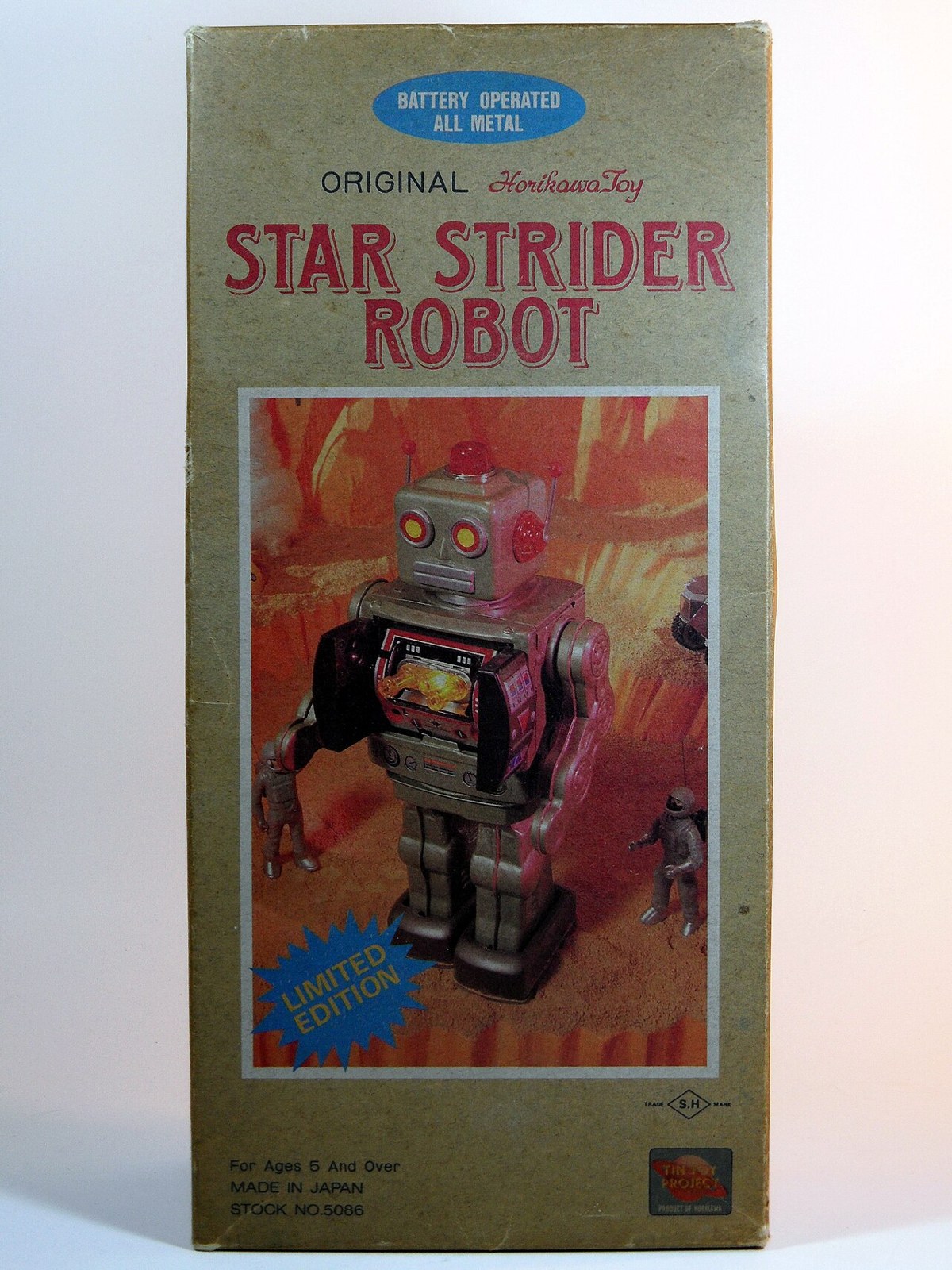
Postwar toymakers like Yonezawa, Masudaya and S. H. Horikawa turned tinplate and battery motors into a whole robot civilization for the world’s toy shelves. Horikawa’s specialty was the walker with a lit window in its chest, where gears spun or a little gun flashed as it marched across the floor. The box art is half the toy: an orange alien world, an empty sky and a robot that clearly means business.
Monster Robot
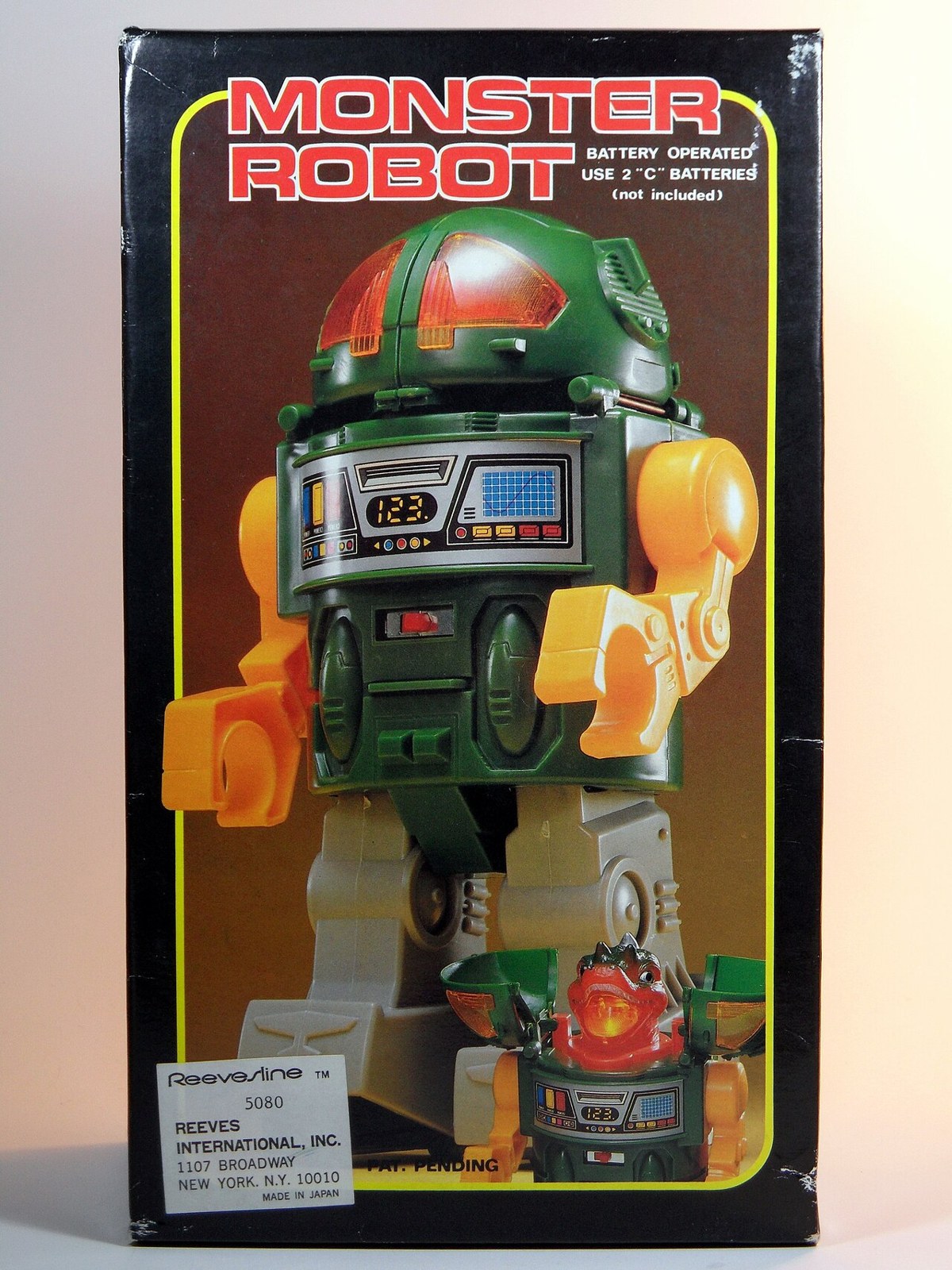
And here is where it lands: green, yellow and red, with a digital readout in its chest and shoulders like a linebacker. You can feel the giant robots of Japanese television pressing on this design from every side. The tin toy of the 1950s has become an action figure, ready for the 1980s.
Now The robot comes home
The machines in this album had hard lives. Gakutensoku vanished. Target Earth’s invasion force was one man in one suit. But a few of them made it. Elektro survived the scrapyard and still stands in Mansfield, Ohio, cigarette days long behind it. And in 2008 the Osaka Science Museum built a new Gakutensoku, so Nishimura’s calm scholar sits at its desk again, eighty years after it first went on show.
Where the record is uncertain
Robots are well documented. Toy robots, not so much.
- The Horikawa toys. Horikawa made battery-operated robots from the 1960s into the 1980s and reissued many of them later, so dating a particular box is difficult. The two photographed here are from a private collection, and we have not dated them.
- The R.U.R. photograph. The image is described as the Theatre Guild’s touring production of 1928 to 1929. We have not been able to name the photographer or the actors.
- Gakutensoku’s fate. The robot disappeared in the 1930s, possibly while touring abroad. Accounts vary and none can be confirmed.
- Elektro’s numbers. Sources give slightly different figures for its height, weight, vocabulary and number of tricks. We have used the ones in the IEEE Spectrum account.
- The poster artists. None of the three movie posters is signed, and we have not found reliable credits.
Rights, and where these images came from
The R.U.R. photograph and the Televox press photograph were published in the United States in the 1920s and are in the public domain; the Televox copyright was not renewed. The Metropolis set photographs by Horst von Harbou, who died in 1953, are in the public domain. The Gakutensoku photograph is in the public domain in Japan as an old press photograph. The Amazing Stories covers are in the public domain because their copyrights were not renewed; the scans come from the Internet Archive. Robot Monster‘s poster was published without a copyright notice, and the Tobor the Great and Target Earth posters are recorded on Wikimedia Commons as published without notice. The photograph of Elektro was released into the public domain by its photographer, Daderot.
Two kinds of image here are not public domain, and we credit them as their licenses ask. The Unimate photograph is from the Los Angeles Times Photographic Archive at UCLA Library, licensed CC BY 4.0. The photographs of the Horikawa boxes are by D J Shin, licensed CC BY-SA 3.0.
Karel and Josef Čapek, Fritz Lang, Walter Schulze-Mittendorff, Makoto Nishimura, Roy J. Wensley, Robert Fuqua and the Binder brothers made these robots, and their names belong right next to them.
Sources
- R.U.R. and Metropolis (1927 film)
- Gakutensoku and cyberneticzoo: Gakutensoku
- IEEE Spectrum: Elektro the Moto-Man and SMECC: Televox
- Adam Link and Internet Archive Pulp Magazine Archive
- Robot Monster, Tobor the Great and Target Earth
- Unimate and UCLA Library: Robot courtesy, 1967
- Kawasaki Robot Division history and Waseda University: WABOT
- Astro Boy, Tetsujin 28-go, Mecha anime and manga, Getter Robo and Chogokin
- Image records and rights tags on Wikimedia Commons
Previously in The Bestiary: the atomic monster, the swamp creature and the ghost. Spotted an error, or still have a tin robot from your childhood that belongs in this guide? Tell us. This is meant to be corrected.


Leave a Reply