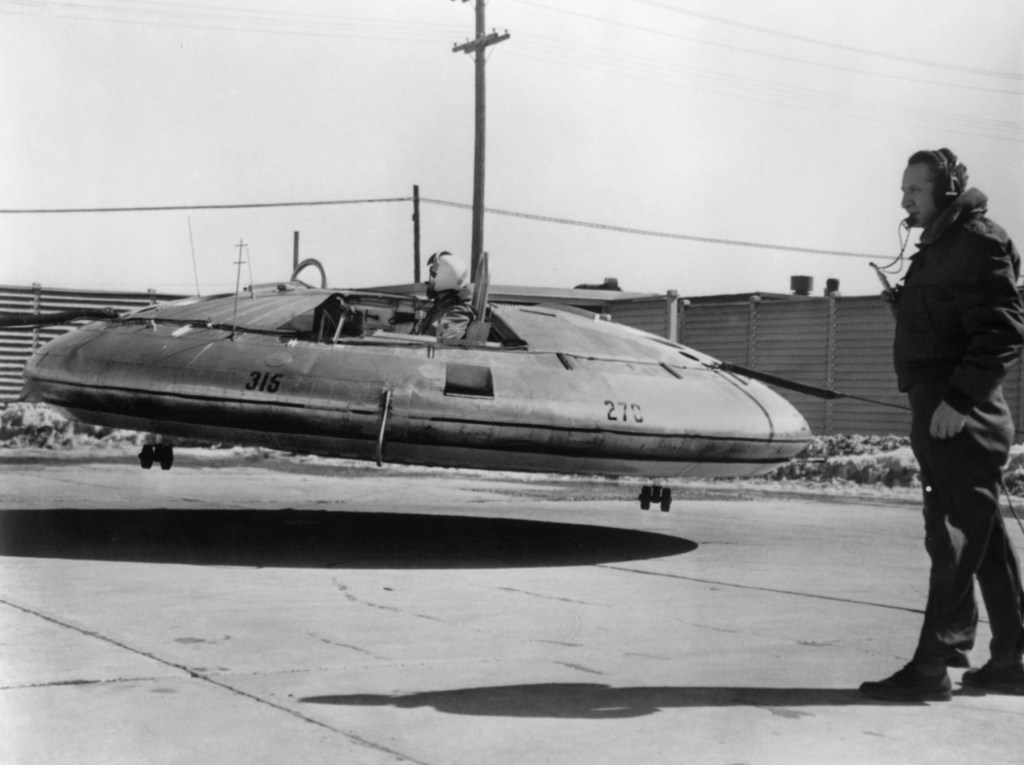
Shapes of the Future · 01 · The Flying Saucer
Ask anyone to draw a spaceship from another world and you get the same thing every time: a disc with a dome on top. Nobody has ever seen one land. So where did the drawing come from? A magazine illustrator painted it in 1929. A newspaper headline gave it a name in 1947. Hollywood spent the 1950s building fleets of them out of aluminum and thread. And then, just when you think the whole story is make-believe, the United States Air Force went and built a real one!
The robots in our last album were things we built on purpose. The flying saucer is stranger than that. It is a shape we made up, convinced ourselves we had seen, and then tried to build for real, first as an aircraft and finally as a house you could park in the hills above Los Angeles.
Here is the whole flight plan in ten seconds. Then the long version, with the pictures to prove it.
- 1929 Frank R. Paul paints a giant disc carrying off a skyscraper for Science Wonder Stories.
- 1946 Paul paints a whole fleet of domed discs on the back of Amazing Stories.
- June 1947 Pilot Kenneth Arnold reports nine shining objects near Mount Rainier, and the headlines call them flying saucers.
- July 1947 An Army air base in Roswell, New Mexico announces it has captured one, then takes it back within a day.
- 1951 The Day the Earth Stood Still lands a saucer in Washington.
- 1956 Ray Harryhausen animates a fleet, frame by frame, for Earth vs. the Flying Saucers.
- 1957 Amazing Stories devotes an entire issue to saucers.
- 1959 The Avrocar, a real flying saucer built in Canada for the U.S. military, makes its first free flight.
- 1960 John Lautner perches the Chemosphere house on a single column in Los Angeles.
- 1968 Matti Suuronen’s plastic Futuro house arrives by helicopter.
Every picture below is dated and credited wherever the record allows. The rights details are at the bottom.
1929 The saucer before the saucer
The phrase “flying saucer” did not exist until the summer of 1947. The shape is another matter. Eighteen years earlier it was already sitting on American newsstands, painted by the man this site keeps coming back to: Frank R. Paul, the illustrator who decided what the future looked like before anyone else had tried.
The disc over Manhattan
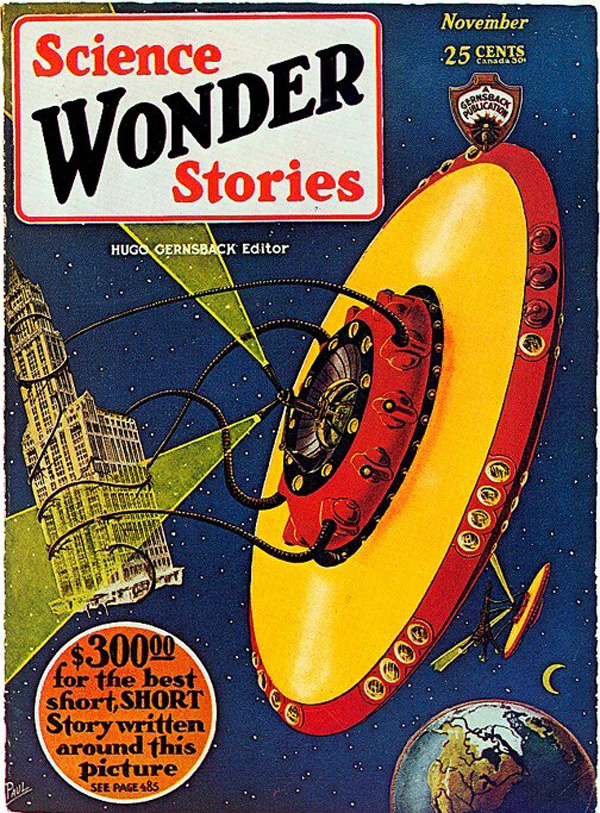
There it is, complete: a round hull, a ring of portholes, a raised center. And it is stealing a skyscraper! Now look at the orange circle in the corner. Gernsback ran the picture as a contest, with $300 for the best short story “written around” it. The saucer came first, and the stories had to catch up.
Stories of the Stars: Altair
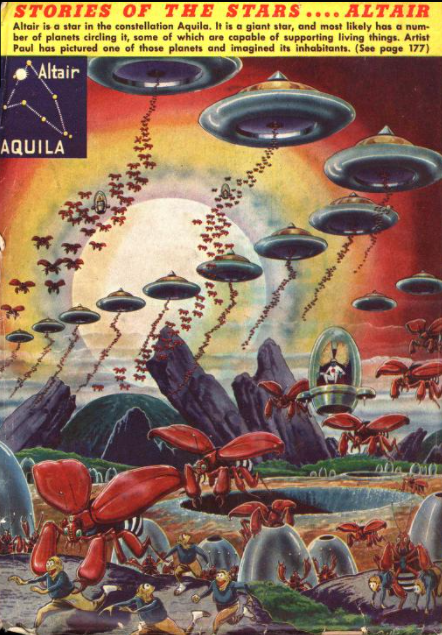
Ten months before anybody reported seeing one, Paul filled a sky with them. Domes on top, discs below, flying in formation over a planet of red crabs. If you had this magazine on your nightstand in the summer of 1947, the newspapers must have felt very familiar.
1947 The summer it got a name
On June 24, 1947, a private pilot named Kenneth Arnold was flying past Mount Rainier in Washington when he saw nine shining objects moving in a chain, at a speed he worked out to be 1,200 miles an hour or more. The next day he walked into the offices of the East Oregonian in Pendleton and told two reporters about it.
Here is the part we love. Arnold always insisted afterward that he had been describing how the things moved, not what they looked like.
Like a saucer if you skip it across the water.
Kenneth Arnold, recalling how the objects moved
He later said that one of the objects was shaped like a crescent. The record is messier than his memory, because the early reports do have him using words like “saucer” and “pie pan.” But the phrase “flying saucer” is not in the first articles the reporters wrote. It seems to have come from the headline desks. The most famous spaceship in history may be named after a way of skipping, not a shape!
Supersonic Flying Saucers
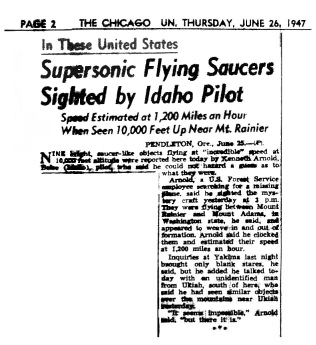
Two days after the sighting, on page 2 of a Chicago paper, the words are already locked together. This small clipping is possibly the first time “flying saucers” ran in a headline. Notice it is tucked under a column called “In These United States,” next to whatever else happened that Thursday.
RAAF Captures Flying Saucer
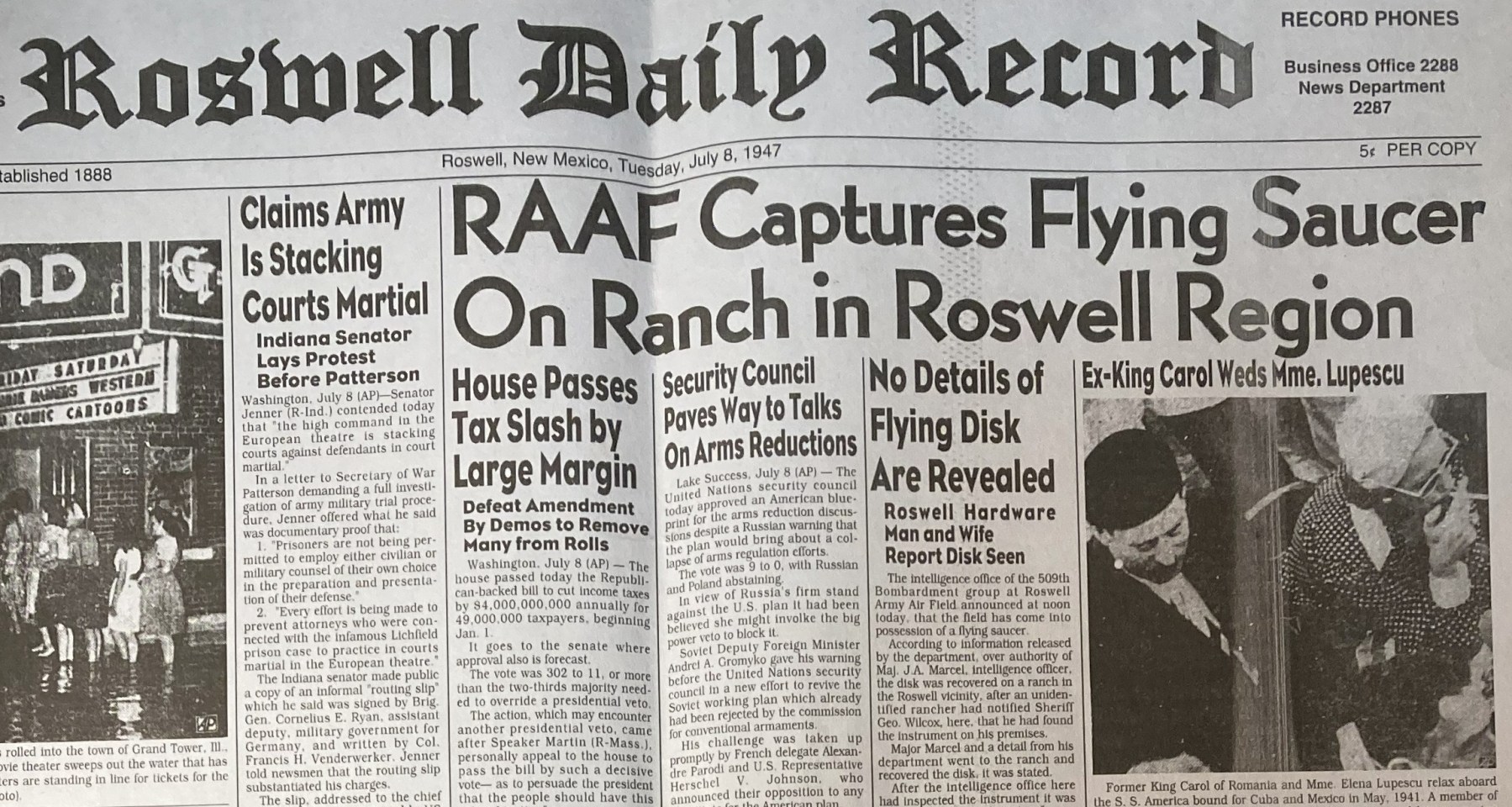
RAAF captures flying saucer on ranch in Roswell region.
Roswell Daily Record, July 8, 1947
Two weeks later the phrase was big enough for a banner. The public information officer at Roswell Army Air Field put out a release saying the base had recovered a “flying disc.” It went around the world, and within a day a general in Fort Worth explained that the wreckage was a weather balloon. It was in fact a balloon from Project Mogul, a secret program built to listen for Soviet atomic tests. The alien version of the story did not arrive until the late 1970s.
1951 Hollywood builds a fleet
Once the saucer had a name, the movies could not leave it alone. A disc was cheap to build, easy to recognize from the back row of a drive-in, and looked terrific on a poster. Through the 1950s it carried peace envoys, invasion fleets and, in one beloved case, grave robbers.
The Day the Earth Stood Still
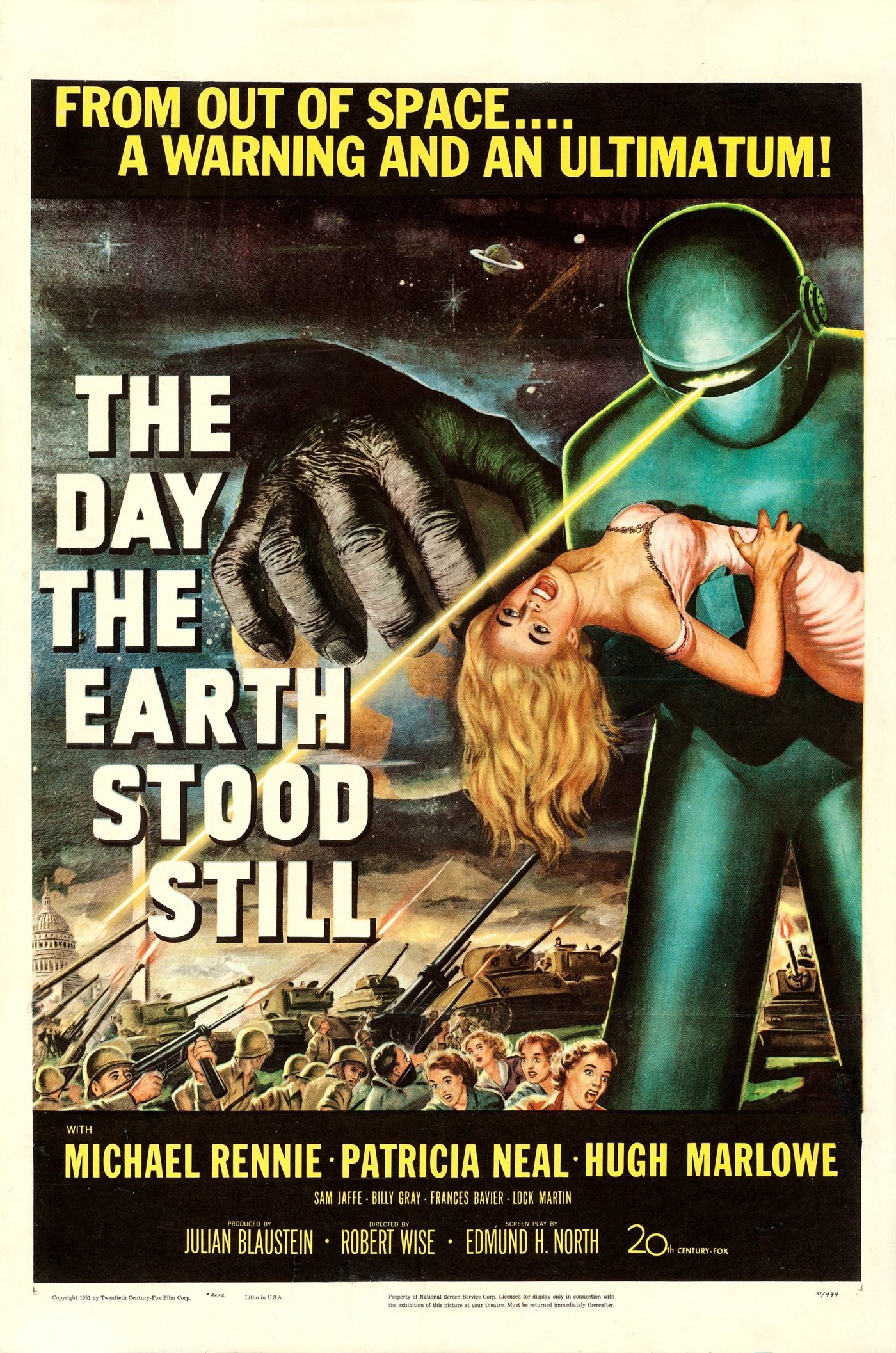
From out of space… a warning and an ultimatum!
The Day the Earth Stood Still poster, 1951
The best saucer movie has a poster with no saucer on it. In the film, a smooth silver disc sets down in Washington and a calm visitor named Klaatu steps out with his robot, Gort, to warn the Earth about its atomic weapons. The poster department kept the robot, put a fainting woman in his arms, and left the spaceship out entirely. The film also gave us the three most useful words in science fiction: “Klaatu barada nikto.”
Earth vs. the Flying Saucers
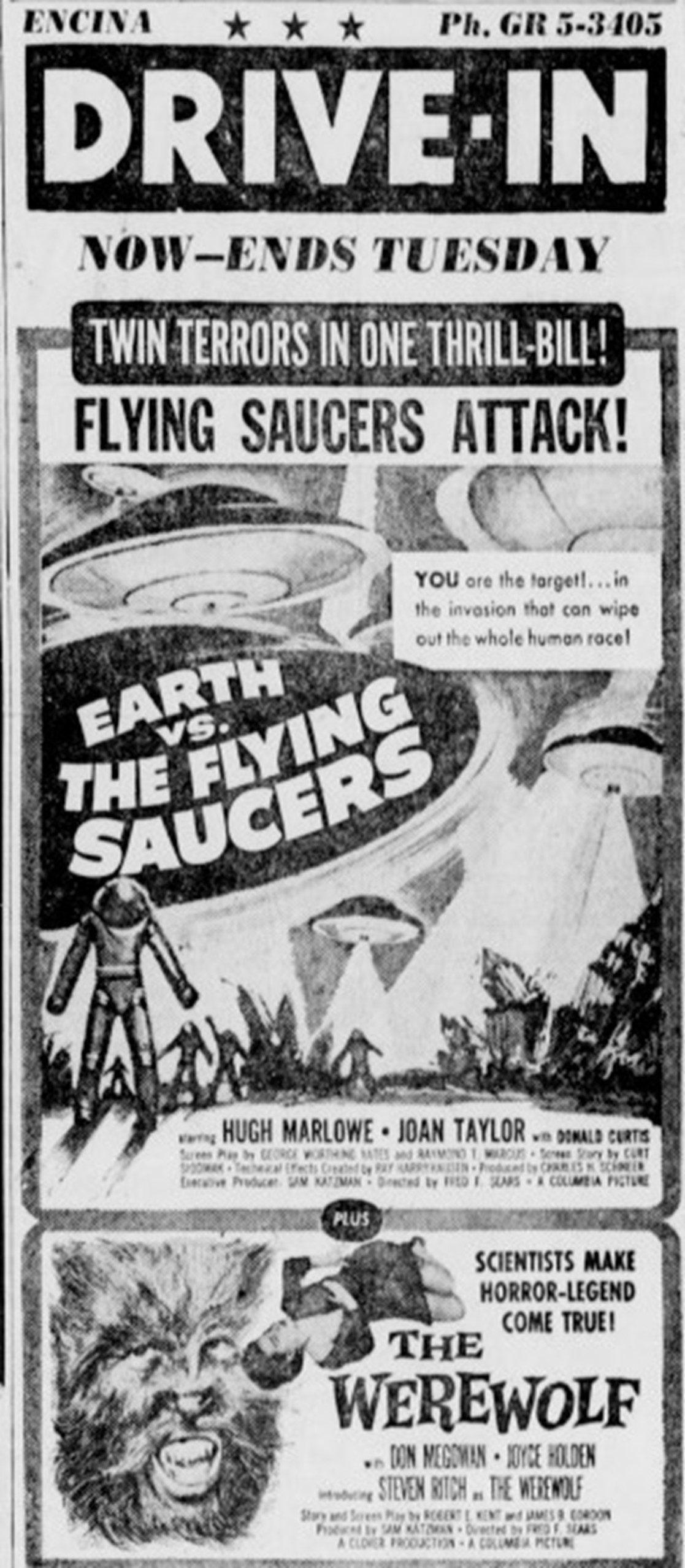
Flying saucers attack!
Drive-in ad for Earth vs. the Flying Saucers, 1956
Five years on, the visitors had stopped giving warnings. This is the saucer as it looked from a car seat in Santa Cruz: a twin bill with The Werewolf, “twin terrors in one thrill-bill.” The fleet on screen was the work of Ray Harryhausen, who moved the saucers one frame at a time, along with every chunk of masonry they knocked off Washington’s monuments. No one has ever made a spinning disc look so mean!
The Special Flying Saucer Issue
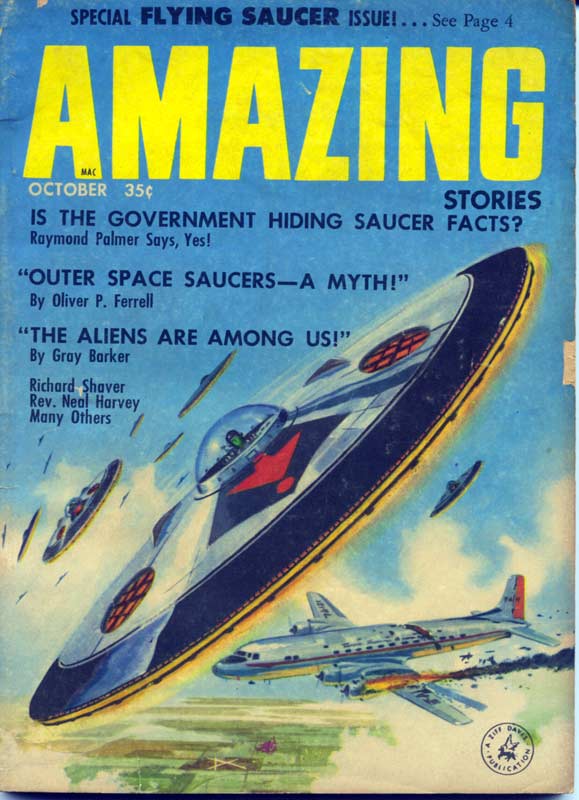
Ten years after Arnold, the magazine that had printed Paul’s discs gave the saucer a whole issue. Read the cover lines from top to bottom and you have the next seventy years of the argument in three lines: the government is hiding it, it is all a myth, and they are already here.
Plan 9 from Outer Space
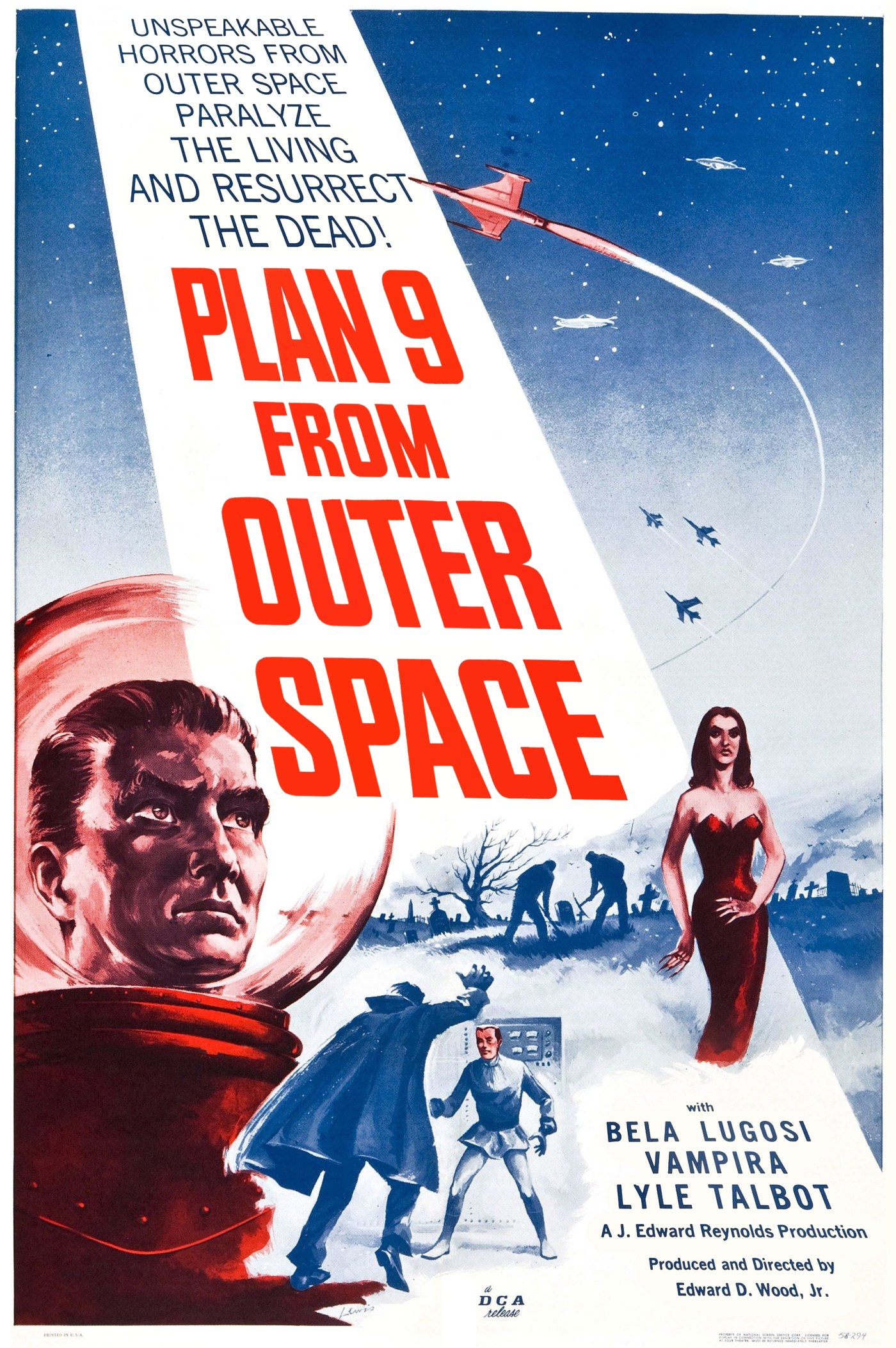
Unspeakable horrors from outer space paralyze the living and resurrect the dead!
Plan 9 from Outer Space poster
And here is where the fleet ends up. Ed Wood shot his saucer epic in November 1956 and previewed it the following March under a better title, Grave Robbers from Outer Space. Its star, Bela Lugosi, had died months before filming began, so he appears in a few minutes of footage shot for a different picture, and a stand-in plays the rest of the part with a cape over his face. It is regularly called the worst film ever made. We have seen it more times than The Day the Earth Stood Still.
1959 The Air Force builds one
Now for the part that sounds made up. While Hollywood was hanging model saucers in front of painted skies, an aircraft company outside Toronto was building a real one, and the United States military was paying for it.
The designer was an engineer named John Frost, who ran the Special Projects Group at Avro Canada. His idea was a disc with a turbine in the middle that blew air out around the rim, so it could lift straight up and then streak away. The U.S. Air Force funded the early studies under names like Project Y and Project 1794. When the Army joined in, the machine got a designation, VZ-9-AV, and a name: the Avrocar.
The Avrocar leaves the ground
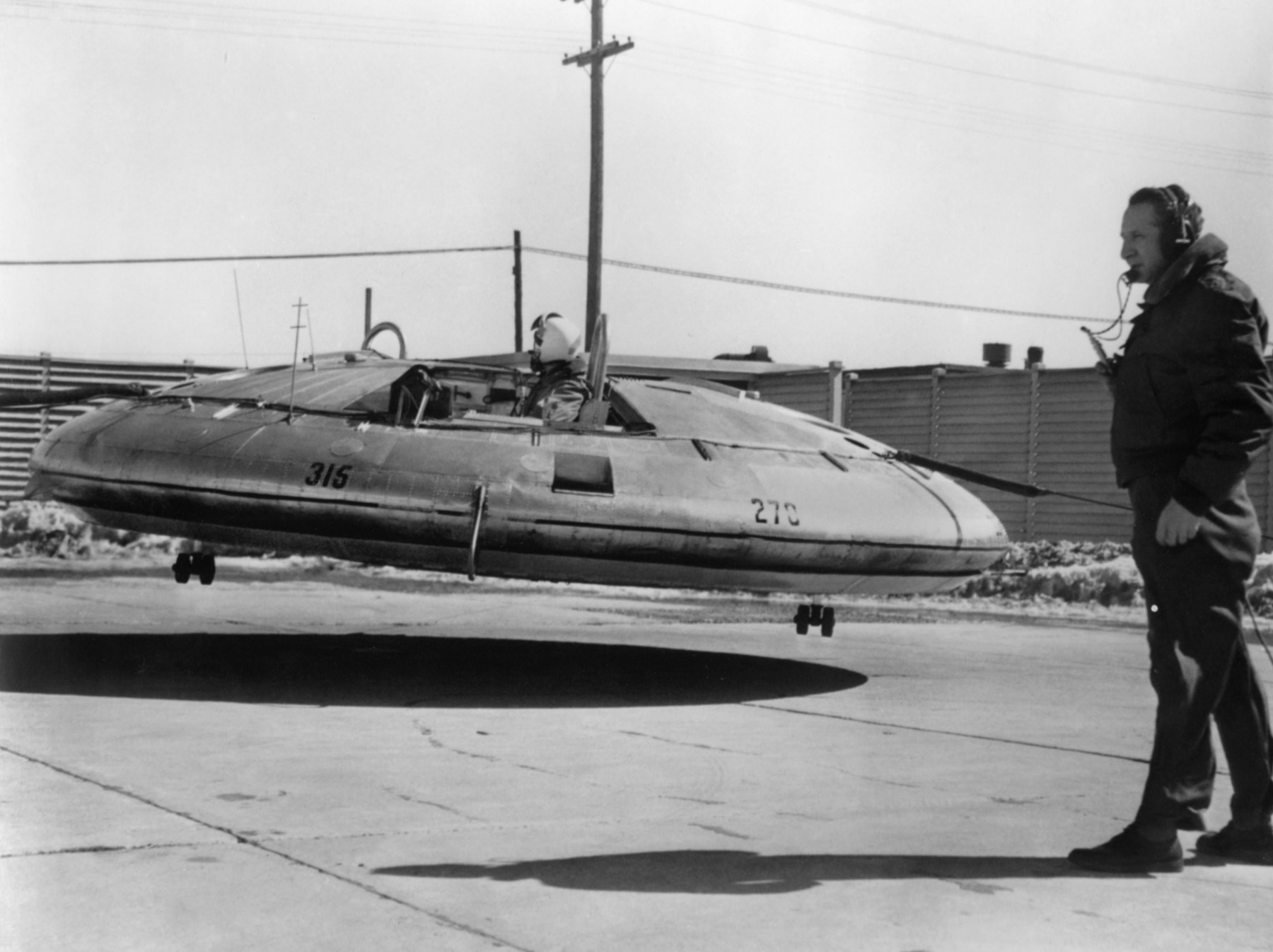
That is not a prop. It is eighteen feet across and three and a half feet tall, and it is hovering. The first tethered hover came on September 29, 1959, and the first free flight on November 12. The brochure promised 225 knots and a ceiling of 10,000 feet. What the Avrocar actually managed was about 35 miles an hour, about three feet off the ground. Any higher and it began to wobble around its rim like a hubcap spun on the pavement, and the wobble got a nickname to match: hubcapping!
A saucer in the wind tunnel
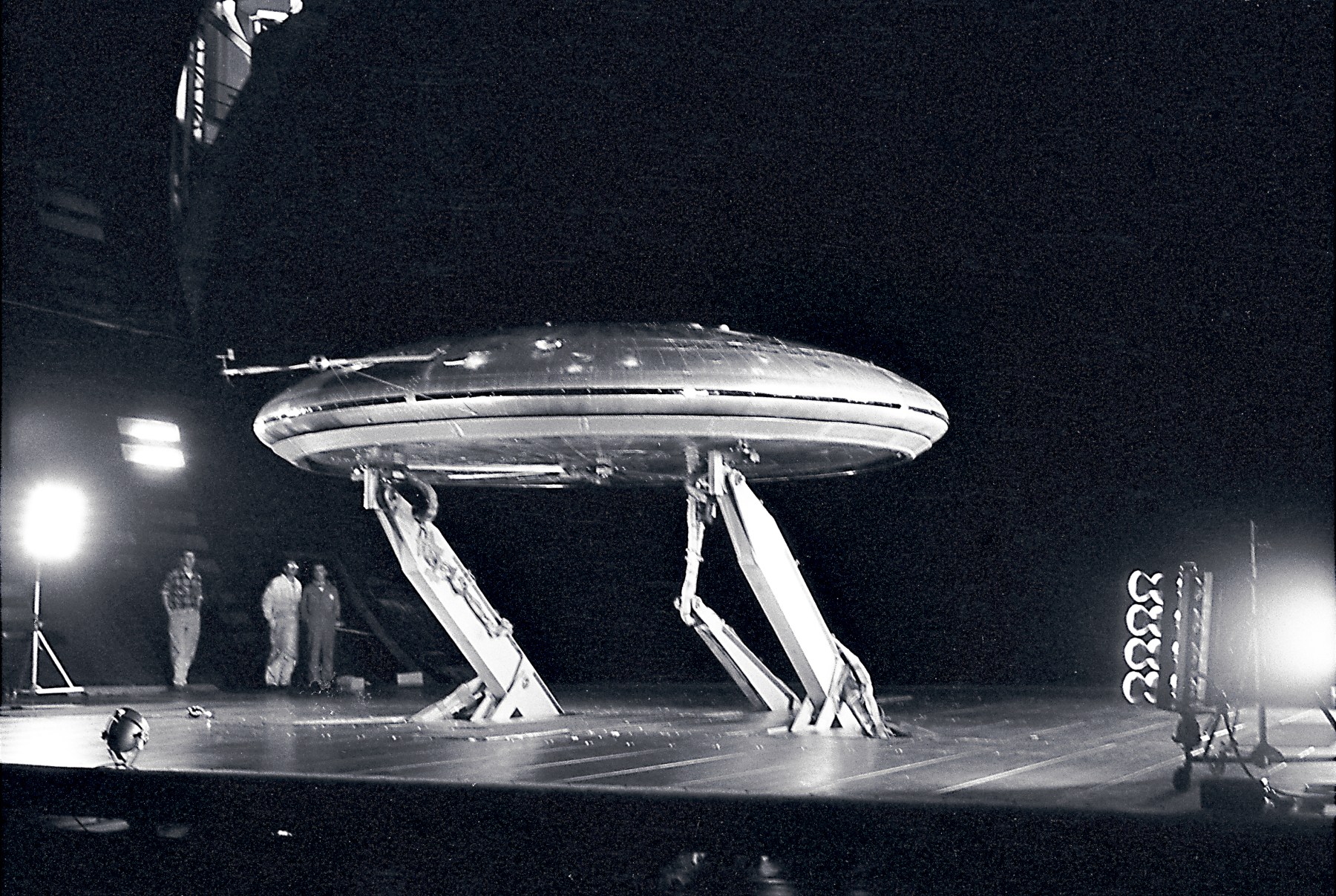
If you showed this photograph to someone without a caption, they would name the movie it came from. It is a NASA record shot. The first Avrocar was shipped to California and mounted in one of the largest wind tunnels in the world so engineers could find out why it would not behave. They never quite fixed it, and the program was cancelled in 1961. Both Avrocars survived. One is at the National Museum of the United States Air Force in Dayton, Ohio, and the other belongs to the U.S. Army Transportation Museum at Fort Eustis, Virginia.
1960 You could live in one
The saucer never did learn to fly properly. So it did the next best thing and settled down. In the 1960s the disc came to rest on hillsides and ski slopes, where it turned out to be a pretty good idea for a house.
The Chemosphere
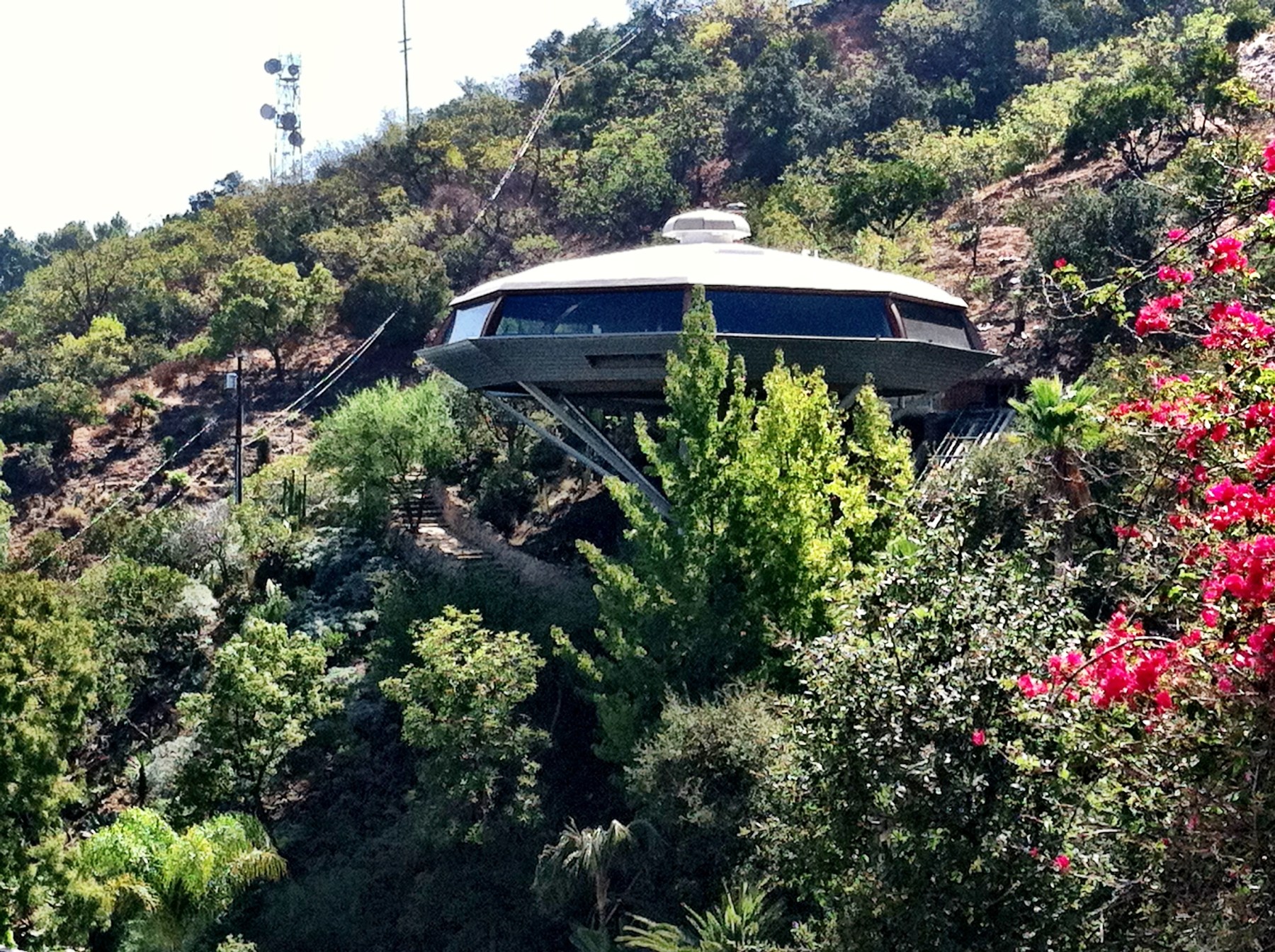
The most modern home built in the world.
Encyclopaedia Britannica, on the Chemosphere
A young aerospace engineer named Leonard Malin was given a lot in the Hollywood Hills that sloped at 45 degrees and was thought to be impossible to build on. John Lautner’s answer was to barely touch it. He set an eight-sided house of about 2,200 square feet on top of a single concrete column, five feet wide and nearly thirty feet tall. It looks as if it landed there last night. Television agreed: it played a house of the future on The Outer Limits in 1964, and a cartoon version later turned up on The Simpsons.
The Futuro
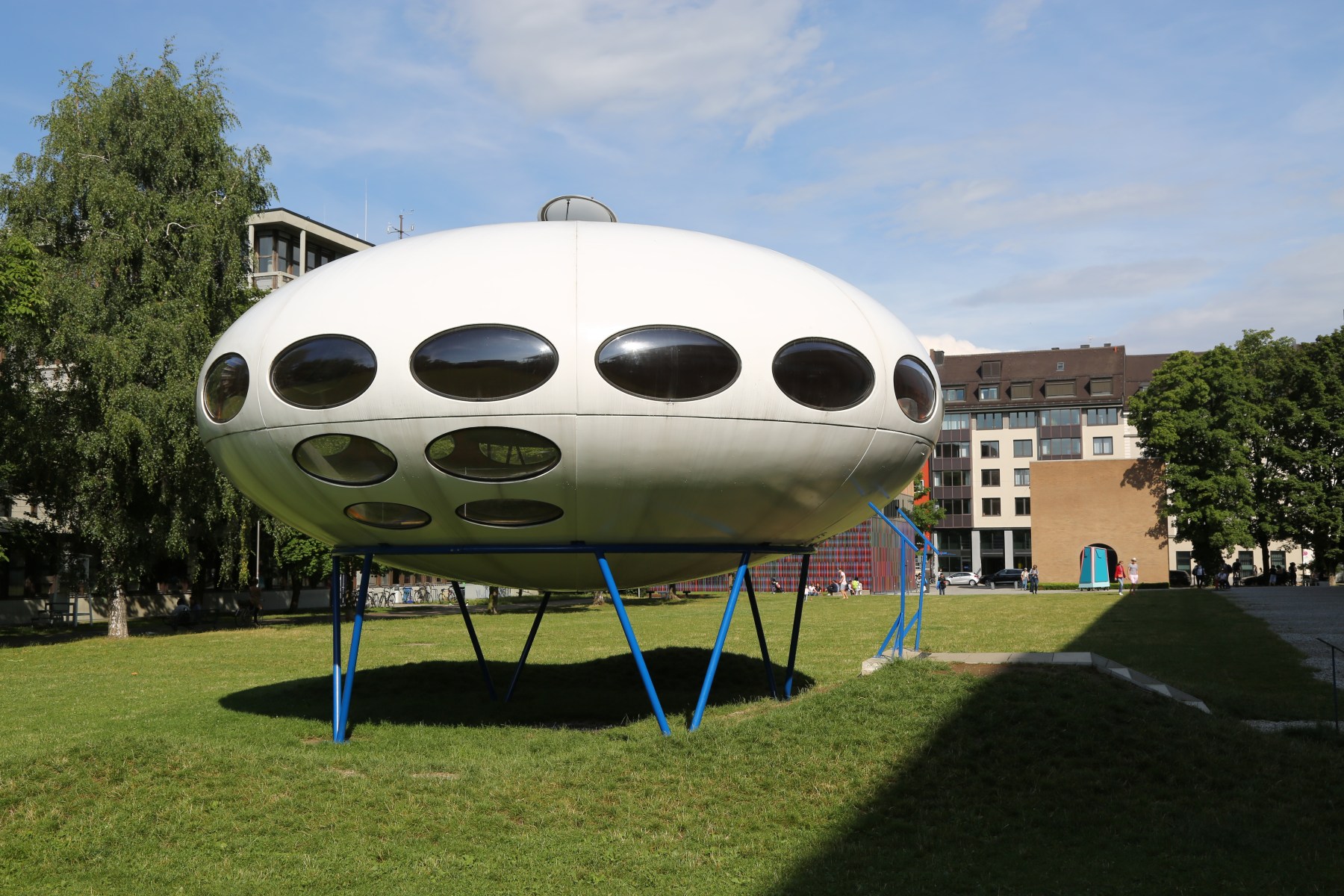
And here is the saucer you could order. The Finnish architect Matti Suuronen designed the Futuro as a ski cabin, something “quick to heat and easy to construct in rough terrain.” It is a plastic shell about 26 feet across, made of sixteen pieces that bolt together, and it could be flown to its site in one piece under a helicopter. A flying saucer, delivered by air! Fewer than a hundred were made before the 1973 oil crisis sent the price of plastic through the roof. About sixty are thought to survive, in museums, in backyards and on at least one college campus.
Now The shape that stuck
Rockets won the actual space race, and nothing that has left this planet looks remotely like a disc. It does not matter. Put a dome on a circle and every person alive knows what you mean, whether it is painted on a cover in 1929, bolted together in an Ontario hangar or balanced on a column over the San Fernando Valley.
That is some career for a shape that started as one illustrator’s guess. Frank R. Paul never saw the Avrocar, as far as we know. We like to think he would have recognized it immediately, and asked why it was flying so low.
Where the record is uncertain
- What Arnold said. Arnold maintained that he described the objects’ motion and was misquoted about their shape. Early reports do attribute words like “saucer” and “pie pan” to him. Both things can be true, and the accounts do not fully agree.
- The first headline. The Chicago Sun clipping is described by its archive record as perhaps the first headline use of “flying saucer.” We have not been able to rule out an earlier one.
- The Avrocar’s numbers. Sources disagree on its best speed, and on whether the program ended in September or December 1961. We have used the figures in the aircraft’s main reference entry and given only the year.
- The Avrocar photograph. The Air Force photo of the tethered flight is undated. We have placed it at about 1959, when tethered tests began.
- Plan 9’s date. The film was shot in 1956, previewed in 1957 and reached general release in 1958 and 1959, so you will see all four years attached to it.
- The unsigned art. We have not found reliable credits for the 1957 Amazing Stories cover or for either movie poster.
Rights, and where these images came from
The 1929 Science Wonder Stories cover, the 1946 and 1957 Amazing Stories covers, the Roswell Daily Record front page and both movie posters are recorded on Wikimedia Commons as public domain in the United States because their copyrights were not renewed. The Chicago Sun clipping and the drive-in advertisement are recorded there as published without a copyright notice. The Avrocar photographs are works of the U.S. Air Force and NASA and are in the public domain.
Two photographs here are not public domain, and we credit them as their licenses ask. The Chemosphere photograph is by evdropkick, licensed CC BY 2.0. The Futuro photograph is by Henning Schlottmann, licensed CC BY-SA 4.0. Both have been resized.
Frank R. Paul, Hugo Gernsback, Ray Harryhausen, John Frost, John Lautner and Matti Suuronen made these saucers, and their names belong right next to them.
Sources
- Kenneth Arnold UFO sighting and Roswell incident
- The Day the Earth Stood Still, Earth vs. the Flying Saucers and Plan 9 from Outer Space
- Avro Canada VZ-9 Avrocar
- Chemosphere and Futuro
- Image records and rights tags on Wikimedia Commons
More from the archive: the robot, and Frank R. Paul, the man who invented what the future looks like. Spotted an error, or grew up near a Futuro? Tell us. This is meant to be corrected.


Leave a Reply