Kitchens of Tomorrow · A Thanksgiving Recount
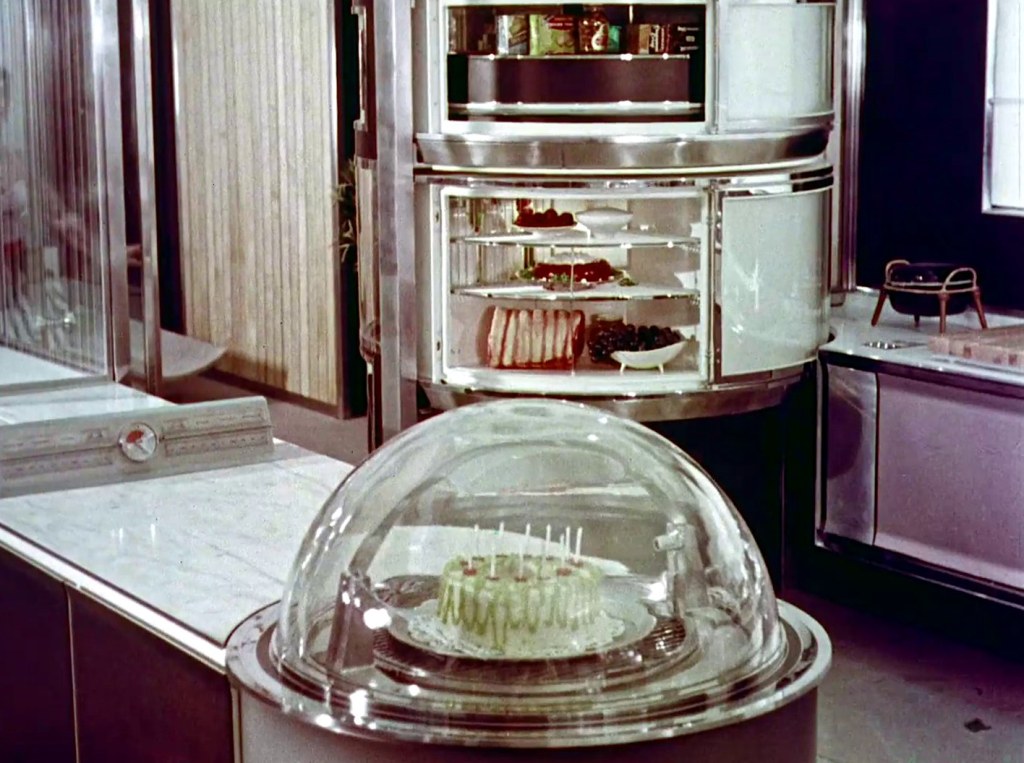
A dancer in a striped apron slides a recipe card into a slot in the kitchen wall, and a color picture of the finished dish lights up on a screen above the counter. A mixer drops down from under the cabinet into the bowl. Then she sets a timer, leaves the room to dance, and comes back to a birthday cake waiting under a glass dome, candles already in it.
That was Frigidaire’s Kitchen of Tomorrow, as General Motors filmed it in 1956, and it is the first of three show kitchens from the late 1950s that told Americans what cooking was about to become. Thanksgiving is a week away, so we took out the Tomorrow Ledger‘s rubber stamps and checked their promises against the kitchens we actually got.
- 1955 Tappan sells the first microwave oven made for homes, the wall-mounted RL-1, for $1,295.
- 1956 Frigidaire’s Kitchen of Tomorrow stars in GM’s Motorama film Design for Dreaming.
- 1957 The RCA Whirlpool Miracle Kitchen promises a cake in three minutes.
- June 12, 1957 Monsanto’s House of the Future opens at Disneyland.
- July 1959 American kitchens go on show in Moscow, and Nixon and Khrushchev argue in one of them.
- 1967 Amana’s countertop Radarange goes on sale for $495, and the House of the Future closes.
- 2002 A robot that cleans the floor by itself finally reaches the shops.
1956 Put a card in the slot
Design for Dreaming is a nine-minute musical that General Motors sponsored to sell its 1956 Motorama, the traveling car and appliance show that opened at New York’s Waldorf-Astoria and, according to the National Film Preservation Foundation, drew 2 million people across five cities. MPO Productions made it, and the dancer Thelma “Tad” Tadlock floats through the show floor in a dream, past the new Cadillacs and into the kitchen.
The song explains the first gadget for her: “Put a card in the slot and onto the screen pops a picture of just how your dish will look, plus all the ingredients you need to cook.” On the screen appears a tall ring-shaped dessert with a scalloped trim, very much the party food of 1956.
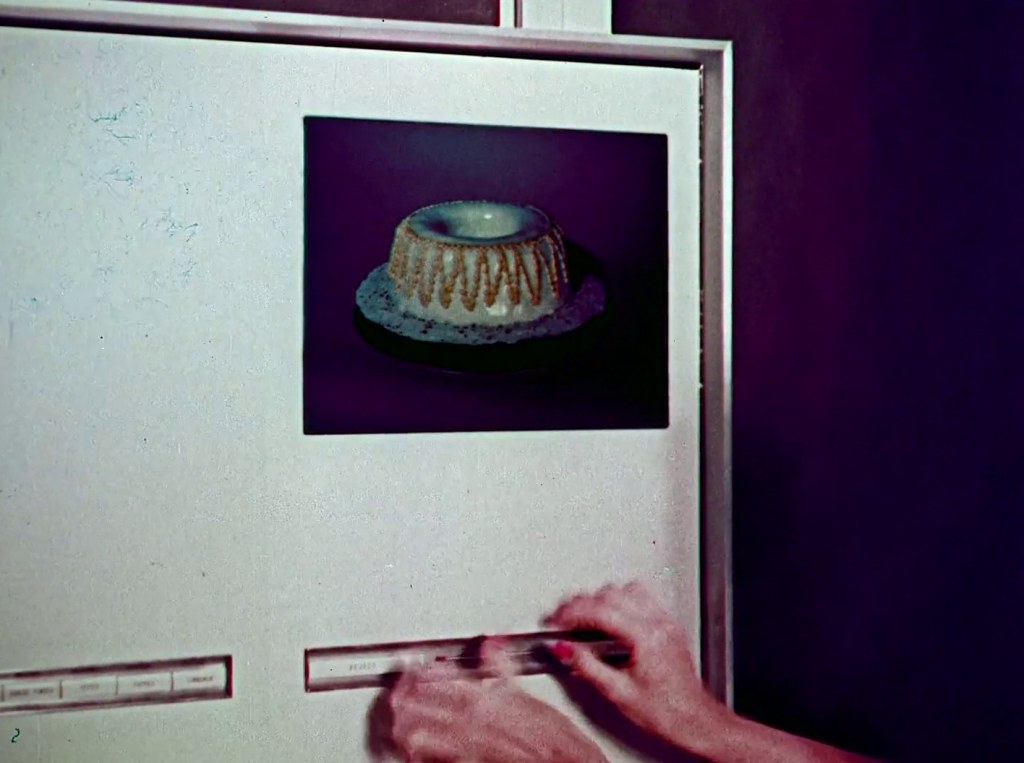
Frigidaire’s recipe screen sat flush in a white wall of cabinets, with the card slots in a row underneath like the buttons on a radio.
VERDICT: ARRIVED WEIRD. The picture of the dish and the list of ingredients made it into most kitchens. They arrived on the phone propped against the flour bag, not in the wall.
1956 Set the timer and go dance
The rest of the Frigidaire kitchen is built in curves and glass. The refrigerator is a round two-tier tower with curved doors, the oven is a glass dome on a pedestal in the middle of the room, and the song promises that “whether you bake or broil or stew, the Frigidaire kitchen does it all for you.” Then comes the line every Thanksgiving cook will recognize:
Don’t have to be chained to the stove all day. Just set the timer and you’re on your way.
Design for Dreaming, 1956
She does exactly that. “Tick tock, tick tock, I’m free to have fun around the clock,” she sings, and the film cuts to her dancing in one outfit after another, from white shorts to a pink swimsuit and a big green sun hat. When she comes back, she lifts the dome and there is the cake.
VERDICT ON THE CAKE THAT BAKES ITSELF: RUNNING LATE. Ovens learned to switch on and off by timer. Nobody has yet built one that lets the cook leave the kitchen on the fourth Thursday of November.
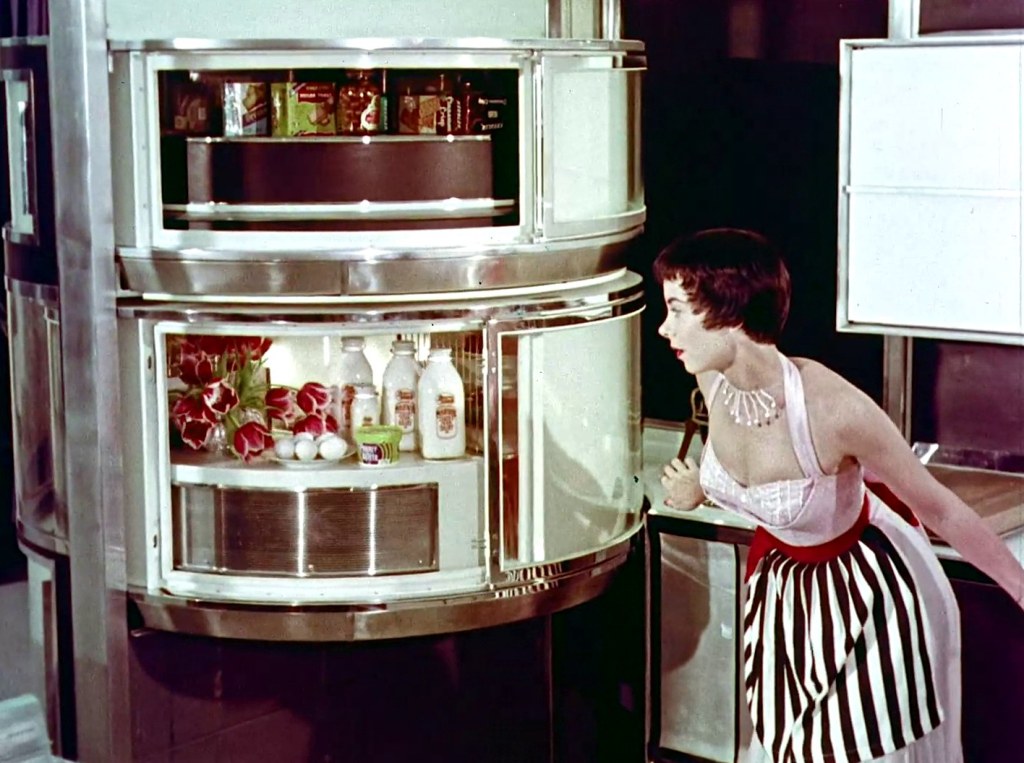
The refrigerator of tomorrow, stocked with milk, eggs and a vase of tulips. We have no idea why the tulips needed to be kept cold, and the film never says.
1957 A cake in three minutes
RCA and Whirlpool answered with the Miracle Kitchen, which had its own promotional film in 1957. “In this kitchen you can bake a cake in 3 minutes,” the narrator says, as Paleofuture transcribed it. When Look magazine photographed the kitchen in 1959, its caption explained how: the oven “operates on the microwave principle.”
That part was real. Tappan had put the first microwave oven designed for homes on sale in 1955, a wall-mounted unit called the RL-1, at $1,295, which IEEE Spectrum reckoned at almost $11,000 in 2016 money, putting it out of reach for most families. It took until 1967, after Raytheon bought Amana, for the countertop Radarange to arrive at $495.
VERDICT: ARRIVED! The fast oven became an ordinary kitchen appliance. Ours mostly reheats leftovers, which, on the Friday after Thanksgiving, is plenty.
1957 The floor that cleaned itself
The Miracle Kitchen had more tricks. At the press of a button its dishwasher “walks” along an electronic track to the dining table, and a little robot floor cleaner roams the room on its own. Or seemed to. Joe Maxwell, who worked on the kitchen at the Detroit design firm Sundberg-Ferar, told Paleofuture’s Matt Novak in 2015 how it was done: “They had a two-way mirror with a person sitting behind it that could see the room,” steering the machines by radio.
The floor cleaner came true anyway, 45 years late. On September 18, 2002, iRobot announced the Roomba, $199.95 at Brookstone, The Sharper Image and Hammacher Schlemmer, online that week and in stores that October. iRobot called it the first automatic floor vacuum available in the United States.
VERDICT ON THE FLOOR CLEANER: ARRIVED!
VERDICT ON THE WALKING DISHWASHER: STILL WAITING. The dishes still make the trip to the sink the old way, in somebody’s hands.
1957 A kitchen made of plastic
The third kitchen you could actually walk into. Monsanto’s House of the Future opened at Disneyland on June 12, 1957, four plastic wings cantilevered 16 feet out from a concrete core, designed by the MIT architects Marvin Goody and Richard Hamilton. Its “Atoms for Living” kitchen, Yesterland reports, had a microwave oven and an ultrasonic dishwasher. According to D23, the Disney fan club, there was no refrigerator at all: “cold zones” lowered from what looked like ordinary cabinets.
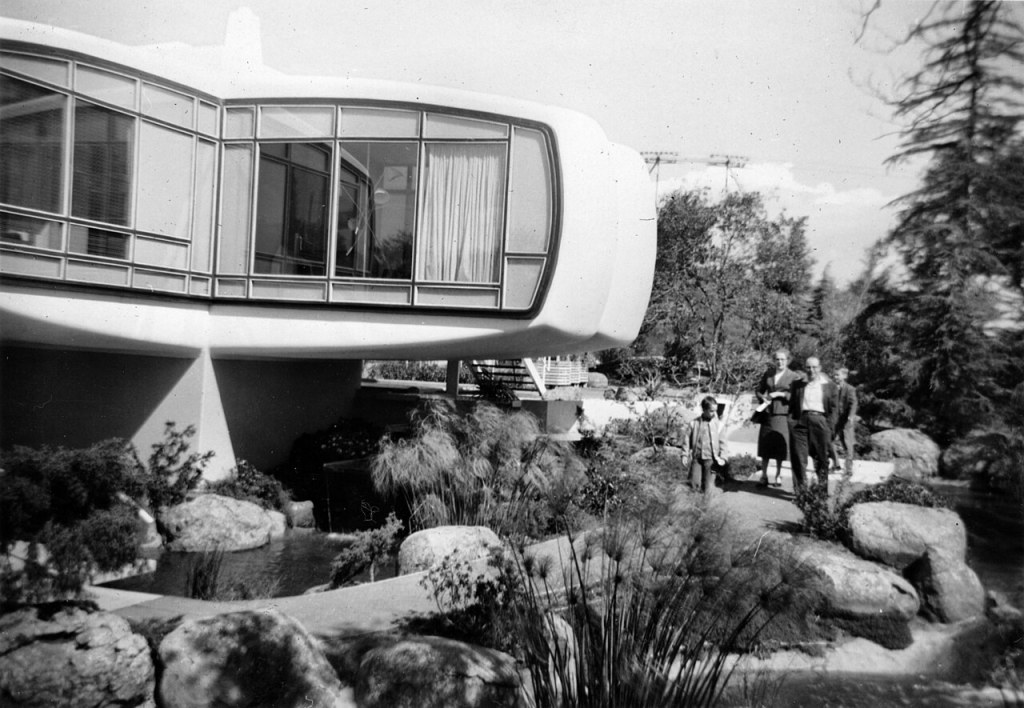
One of the four wings, floating over the garden in 1958. The kitchen and the bathrooms sat together in the core at the center of the cross.
The house closed in December 1967. The story Disney fans still tell is that a one-day demolition took two weeks, because the wrecking ball bounced off the walls and crews had to cut the house apart by hand.
VERDICT ON THE ULTRASONIC DISHWASHER: STILL WAITING. Nearly seventy years on, the dishwasher under your counter still cleans with hot water and spray arms.
1959 The kitchen goes to Moscow
In the summer of 1959 the Miracle Kitchen was shipped to the American National Exhibition in Moscow’s Sokolniki Park, where the United States showed off its cars, televisions and appliances. On July 24, Vice President Richard Nixon walked Nikita Khrushchev through the show, and the two men ended up arguing, of all places, in a kitchen. It was not the Miracle Kitchen. According to Meduza and Indy Week, it was a General Electric kitchen inside a model American house.
One witness was the young press agent for the company that built that house, William Safire, who later became a New York Times columnist. Fifty years on, he put it plainly: “I was in that kitchen.”
- Arrived! The fast microwave oven, 1955 to 1967. The robot floor cleaner, 2002.
- Arrived weird The recipe screen, now a phone propped against the flour.
- Running late The cake that bakes itself while you dance.
- Still waiting The dishwasher that walks to the table. The dishwasher that cleans with sound.
Halfway through Design for Dreaming, as the Dance of Tomorrow begins, the song slips in the truest line in the film: “Everyone says the future is strange, but I have a feeling some things won’t change.” The whole film is free to watch at the Prelinger Archives, and the kitchen starts about three minutes in.
Where the record is uncertain
- The song lyrics. We took the lines from the Prelinger Archives’ notes on the film and checked them against the Internet Archive’s machine transcript. The punctuation is ours.
- How the Miracle Kitchen robots moved. The two-way mirror comes from people who worked on the kitchen, remembering it nearly sixty years later, as told to Paleofuture and Indy Week. No account from 1957 describes it.
- The wrecking ball. Yesterland calls the bounce a legend, and we have not seen a contemporary report of it.
- Which exhibit Khrushchev saw first. Safire says the two leaders were steered into RCA’s color television studio before the kitchen; some later accounts put the kitchen first.
Rights, and where these images came from
The featured image and the two film stills in the story are frames from Design for Dreaming (MPO Productions for General Motors, 1956), which the Prelinger Archives offers as public domain; we took them from the high-resolution copy on Wikimedia Commons. The 1958 photograph of the House of the Future is from the Orange County Archives, Linda Peach Warner Collection (source, CC BY 2.0).
Sources
- Design for Dreaming, Prelinger Archives, and its National Film Preservation Foundation page
- The 1950s Miracle Kitchen of the Future Had Its Own Roomba, Matt Novak, Paleofuture, 2015
- The secrets behind the 1950s Miracle Kitchen of the future, Indy Week
- A Brief History of the Microwave Oven, Evan Ackerman, IEEE Spectrum
- iRobot Introduces Roomba Intelligent FloorVac, iRobot, September 18, 2002
- Monsanto House of the Future, Yesterland, and Monsanto House of the Future Opens at Disneyland, D23
- The Cold War’s Hot Kitchen, William Safire, The New York Times, 2009, via History News Network
- The Kitchen Debate, Meduza, November 2026
More from the archive: The Tomorrow Ledger, where we keep score on the future, and the aluminum Christmas tree, which we pulled out of the 1950s attic last week. If you could install one gadget from these three kitchens, tell us which in the comments.


Leave a Reply