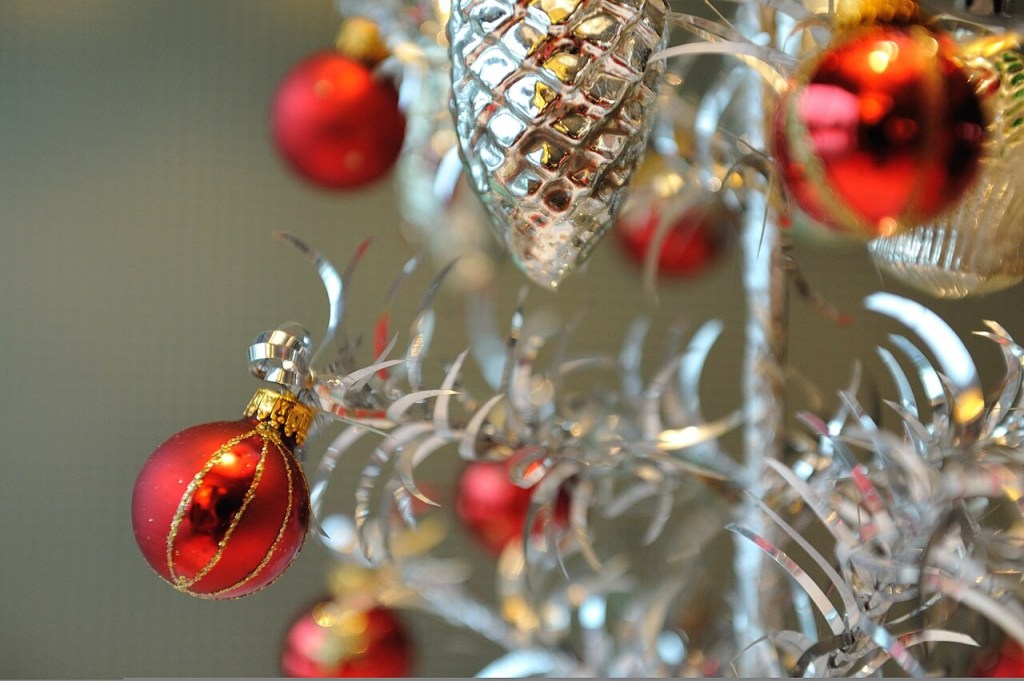
Space Age Holidays · The Aluminum Christmas Tree
In December 1958, Tom Gannon, the toy sales manager at the Aluminum Specialty Company of Manitowoc, Wisconsin, saw a Christmas tree made of metal in a Ben Franklin dime store in Chicago. Within a year his company had made hundreds of thousands of silver trees of its own, and by the end of the 1960s more than a million of them had gone up in American living rooms, glittering under spinning wheels of colored light set on the floor.
This Thanksgiving week, hundreds of them go back into the shop windows of downtown Manitowoc, the town that made them.
- December 1958 Tom Gannon spots a metal tree, made by Modern Coatings of Chicago, in a Ben Franklin store.
- March 1959 Aluminum Specialty shows its own version at the American Toy Fair in New York.
- 1960 The tree gets its name: the Evergleam.
- 1964 to 1965 Sales hit their peak.
- 1965 Lucy sends Charlie Brown out for the biggest aluminum tree he can find. He comes home with a scrawny real one.
- 1971 to 1972 Production ends.
- November 2026 Hundreds of Evergleams fill the shop windows of downtown Manitowoc again.
1958 A tree in a Chicago dime store
The tree Gannon saw in Chicago was made by a firm called Modern Coatings, and it was too expensive and too bulky to sell to everybody. Back in Manitowoc, an engineer named Richard Thomsen led the work on a cheaper version. Aluminum Specialty then signed a licensing deal with Modern Coatings, which held patents on two clever details: the paper tube each branch was stored in, and the angle of the holes drilled in the trunk so that every branch hung the same way.
The company showed its tree at the American Toy Fair in New York in March 1959 and had hundreds of thousands made in time for that first Christmas. It was careful with one word, too. According to the Wisconsin Historical Society, Aluminum Specialty never advertised its trees as “artificial.”
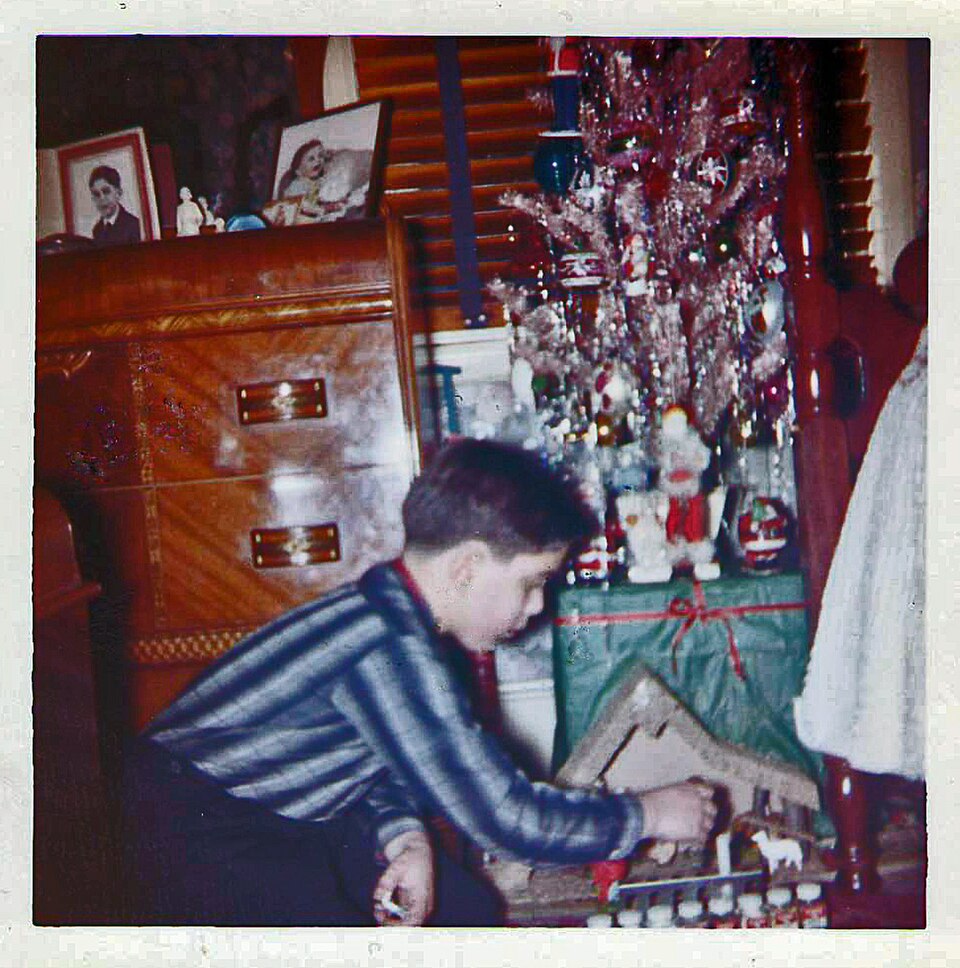
A family snapshot from December 24, 1959, the Christmas Aluminum Specialty’s first trees reached the shops. The branches are hung thick with glass balls, a Santa figure stands underneath, and a boy in a striped shirt is setting up a little stable scene on the floor. The print has drifted toward pink over the years, which we rather like.
1960 Light from the floor
Aluminum conducts electricity. Wind a string of bulbs through a metal tree, let one wire fray, and the whole tree can become live. The U.S. Consumer Product Safety Commission has put it plainly, in a warning quoted by Retro Renovation:
Never use electric lights on a metallic tree.
U.S. Consumer Product Safety Commission
Donna Braden, a curator at The Henry Ford, is drier about it. The tree, she writes, was completely safe unless you “foolishly strung it with electric lights.”
So the light went on the floor. Families set a four-color revolving wheel a few feet away and let the silver take on red, then blue, then green. Aluminum Specialty sold a whole kit of these: a Sata-Lite projector in 1960, then a motorized color wheel, a Revolving Turbo 4-Color Projector with no motor at all that spun on the warm air rising from its own bulb, and revolving tree stands, some of which played “Silent Night” as the tree turned.
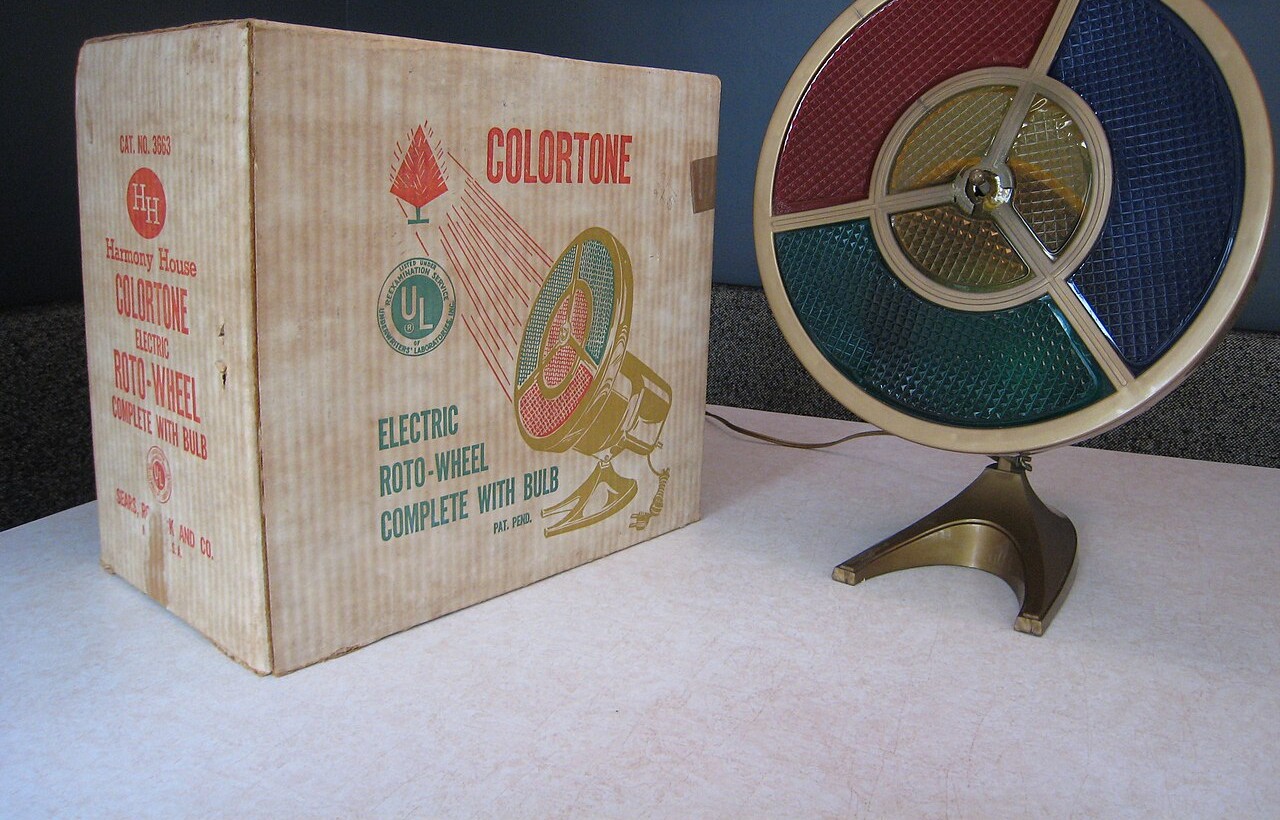
Sears sold its own wheel under the Harmony House name. This is the Colortone Electric Roto-Wheel, “complete with bulb,” with its box still standing. The drawing on the side shows exactly how it was meant to work, a beam of red light aimed at a little tree.
1964 Silver, pink and a peacock
By the middle of the decade the Evergleam was everywhere. The Wisconsin Historical Society credits it with 60 to 65 percent of the aluminum tree market in the United States and Canada through the 1960s. It was sold at Montgomery Ward, Woolworths and Ben Franklin, and the factory sometimes ran three shifts a day. Sales peaked in 1964 and 1965.
You could buy one as small as a two-foot tabletop tree or as tall as eight feet, with a five-and-a-half-foot Slim-Line in between. Branches came in Straight Needle, Frosty, Swirl and Fountain, and there was a pom-pom style with curled tips. Three out of four or more were silver, but there were gold, green and pink trees too, and in the late 1960s a Blue Frost with blue tips and a two-tone Dual-Color. Our favorite is the Peacock, a seven-foot tree designed to sit against a wall in tight spaces. It is completely flat, the only Evergleam ever made that way!
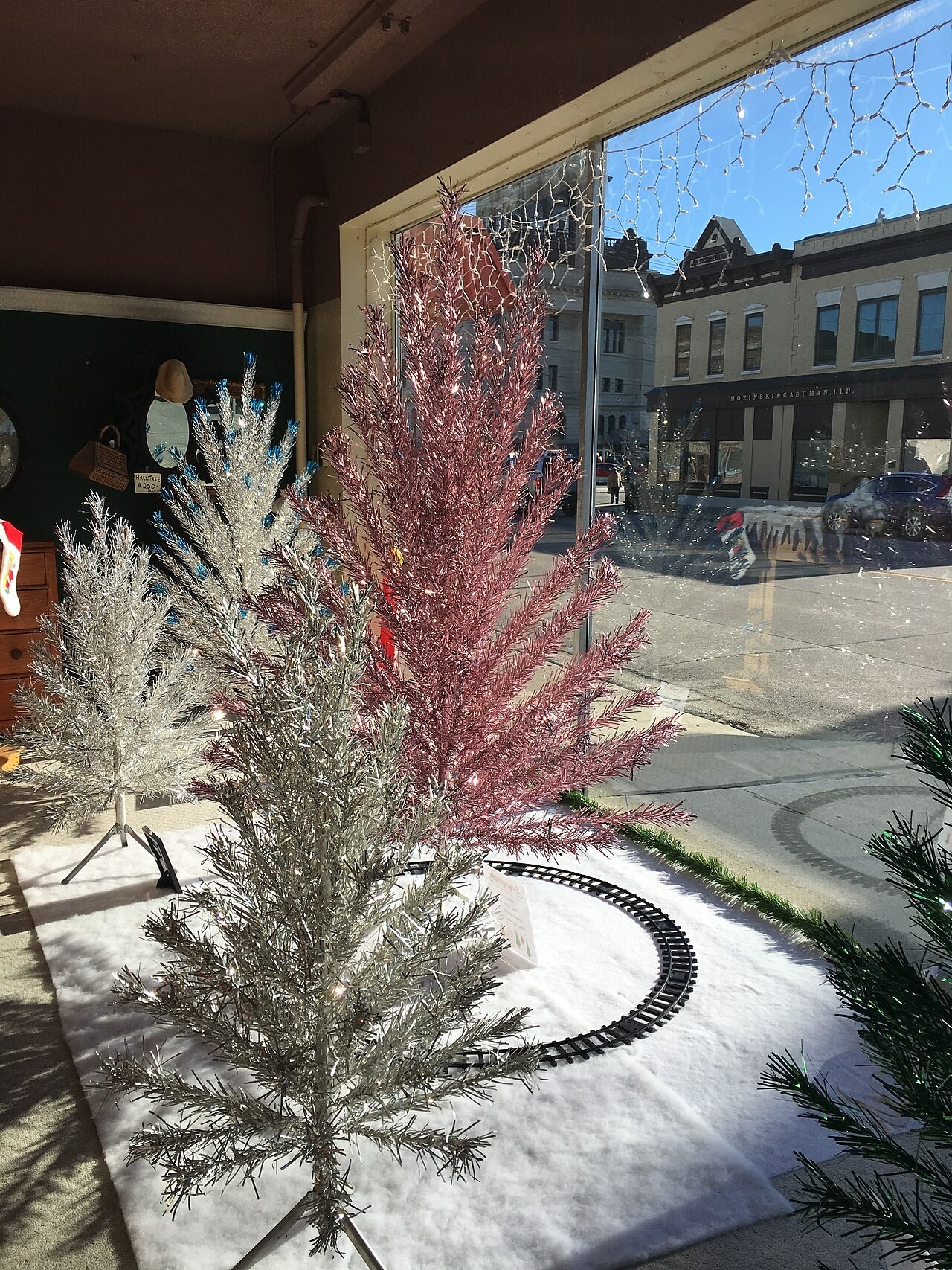
Pink was one of the rarest colors Aluminum Specialty made. This pink tree, very likely an Evergleam, stood in an antique mall window in downtown Manitowoc in December 2015, the first year of Evergleams on Eighth, with two silver trees and a blue-tipped one beside it and a toy train track looping through the batting.
1965 The Charlie Brown question
In A Charlie Brown Christmas, Lucy tells Charlie Brown to get the biggest aluminum tree he can find, maybe even painted pink. He comes home with a scrawny real tree instead, and the special has been blamed ever since for ending the silver tree craze.
The curators disagree about that. Joe Kapler, the Wisconsin Historical Society’s lead curator, told Wisconsin Public Radio in 2019 that he doesn’t give the episode much credence, because sales kept going strong after it aired. Braden at The Henry Ford gives the special some of the blame, but adds that sales had reached their saturation point anyway. Aluminum Specialty stopped making Evergleams in 1971 and 1972.
The pink tree Lucy asked for is now one that collectors chase. In 2014, Mental Floss noted that a rare pink model had once sold on eBay for more than $3,600!
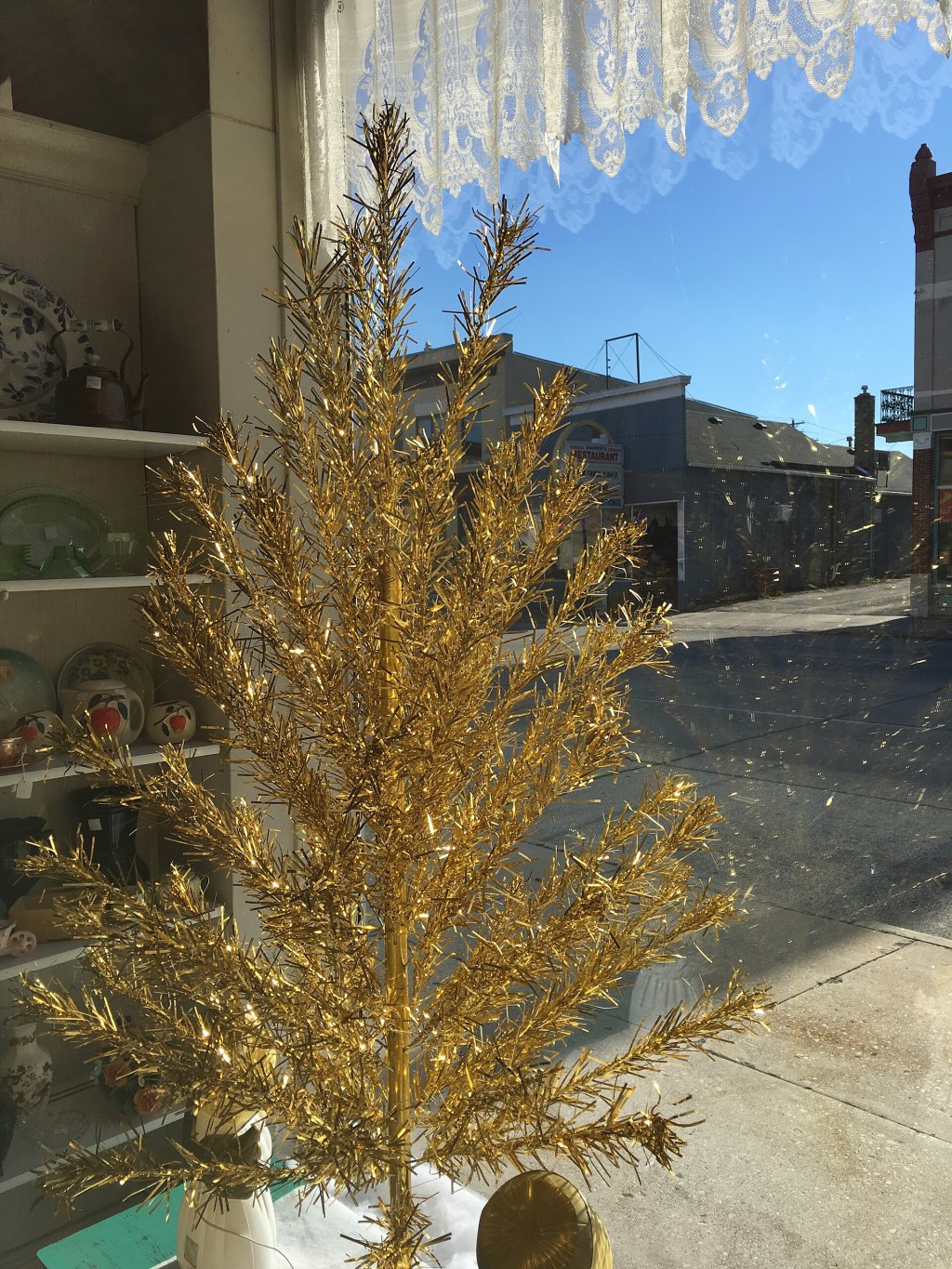
Pink is not the only off color collectors chase. This rare gold Evergleam stood in the window of the same antique mall as the pink tree above, lit by nothing but a clear winter afternoon. No color wheel required!
1997 The people who saved them
Two photographers, John Shimon and Julie Lindemann, began collecting the trees in the 1990s, wrote their first article about them in 1997, and in 2004 published Season’s Gleamings: The Art of the Aluminum Christmas Tree. The Wisconsin Historical Museum in Madison held its first Ever Gleaming exhibit in 2005, and by 2019 the show was in its tenth season.
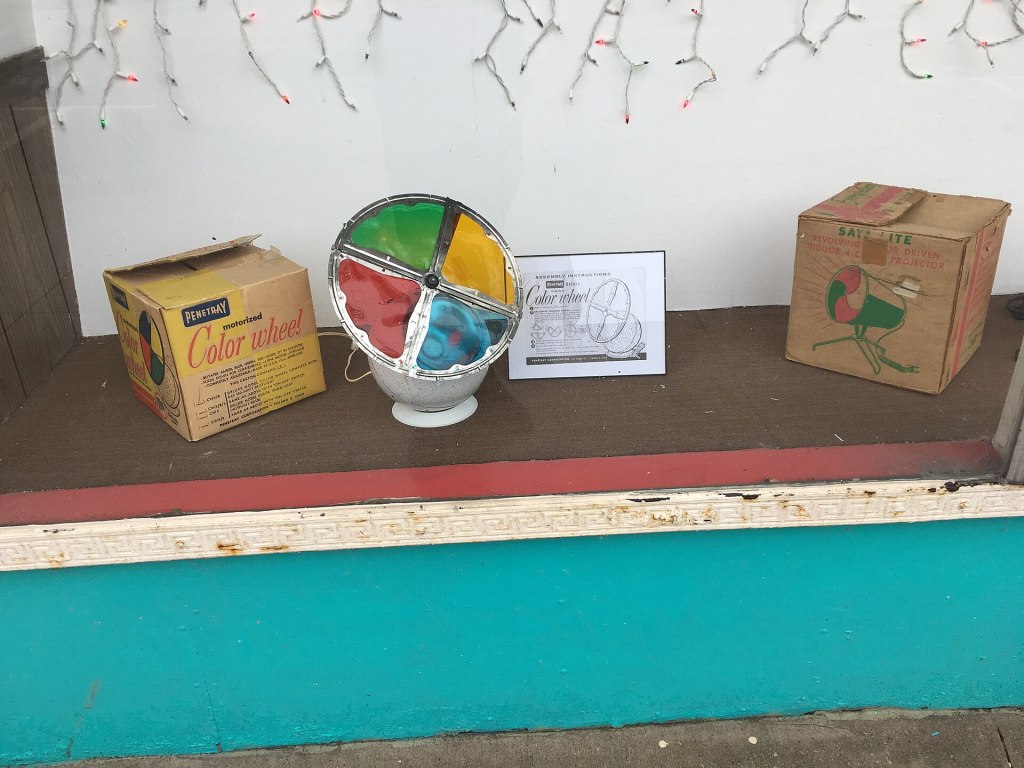
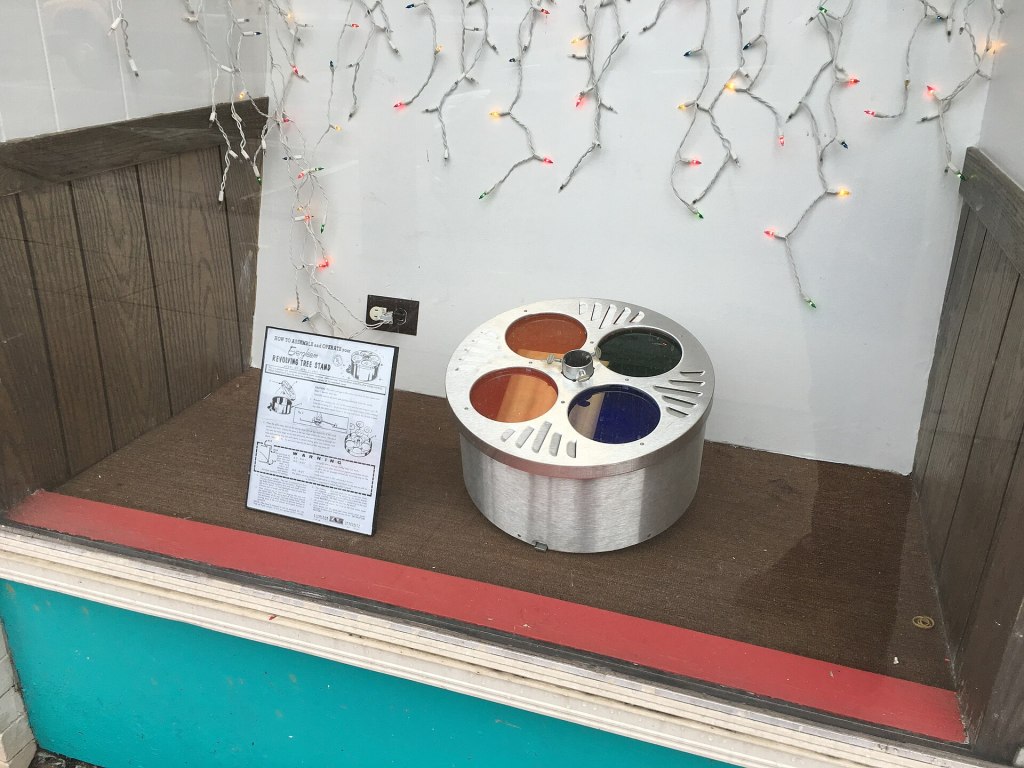
The collectors saved the light along with the trees. One of these is a four-color wheel sitting between its original boxes, and the other is a drum-style wheel parked beside a printed diagram of how it works. Both turned up in the shop windows of Evergleams on Eighth.
Now Back in the windows
Evergleams on Eighth began in 2015. It fills storefronts across the historic downtown with hundreds of Evergleam trees, along with vintage holiday pieces made by Mirro Aluminum and the National Tinsel Company, and there is a big exhibit at the Manitowoc Public Library. Admission is free, and there are guided walking and trolley tours. The 2026 season opens Thanksgiving week (the organizers list November 25, Travel Wisconsin lists November 26) and runs through January 3, 2027.
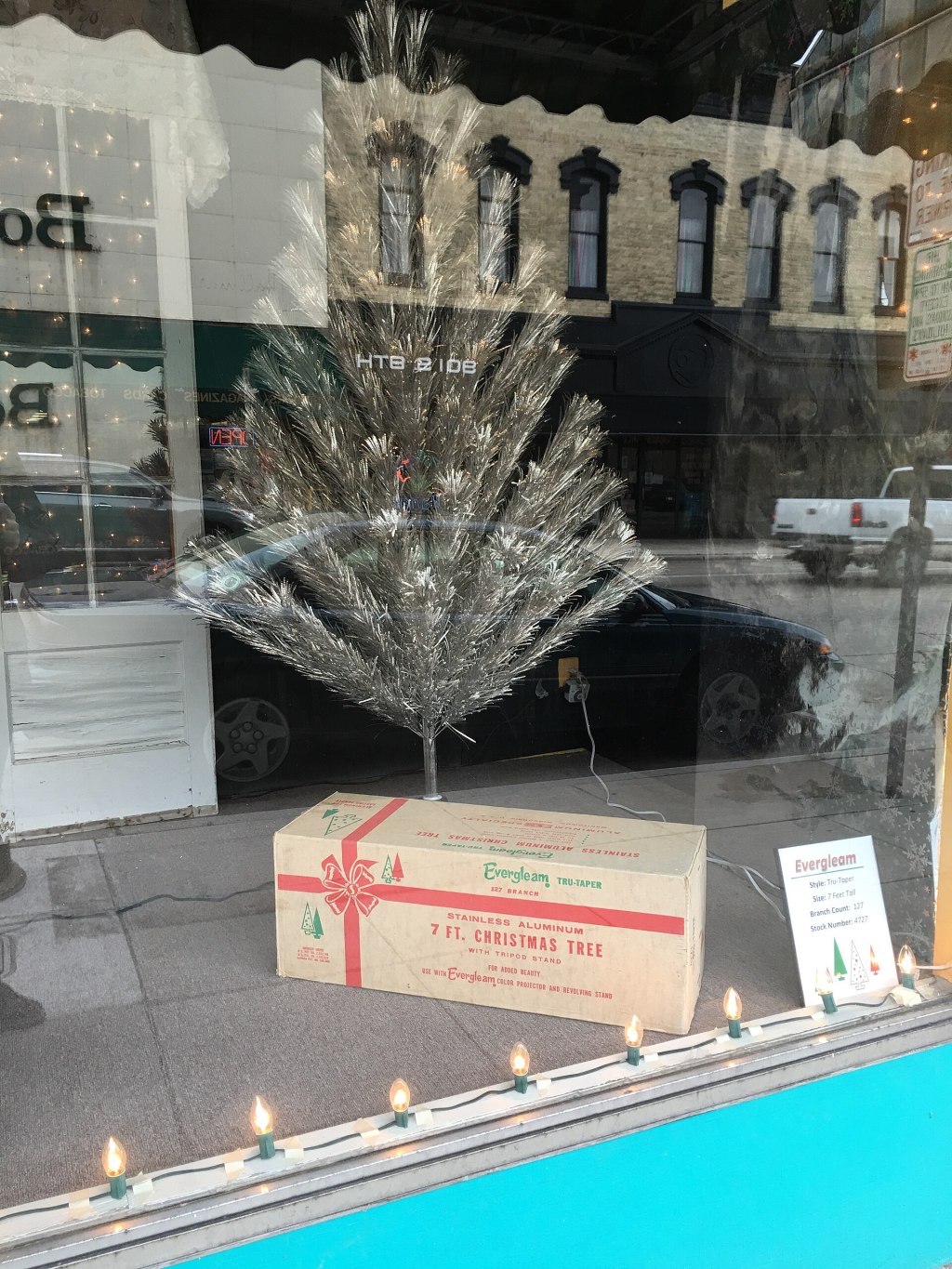
This is what the walk looks like: a seven-foot silver Evergleam in the Village Square window, standing over an original Evergleam box, with the brick fronts of 8th Street mirrored in the glass. Sixty-some years on, the trees are back where people can see them from the sidewalk. If you can get to Manitowoc this winter, go see them in person!
Where the record is uncertain
- How many were made. The Wisconsin Historical Society’s own pages give both “more than one million” and “several million” Evergleams in American homes. The Henry Ford says more than a million were sold between 1959 and 1969. We have used the smaller number.
- When production ended. Most sources, including the Historical Society’s timeline, say 1971 to 1972. A 2017 radio piece says the late 1970s.
- Charlie Brown’s role. Kapler is skeptical. Braden gives the special some of the blame, alongside a saturated market. Nobody we read has sales figures that settle it.
- The 2026 opening day. Evergleams on Eighth lists November 25. Travel Wisconsin lists November 26.
- The two trees in our pictures. The 1959 snapshot is filed on Wikimedia Commons as an aluminum tree, and we do not know who made it. We believe the pink tree in Manitowoc is an Evergleam, but the photograph alone cannot prove it.
Rights, and where these images came from
All eight photographs come from Wikimedia Commons and are used under their Creative Commons licenses. The Christmas Eve 1959 snapshot is by Jim, the Photographer (source, CC BY 2.0). The Colortone Roto-Wheel is by Ataripenna (source, CC BY 2.0), cropped at the top. The five Manitowoc photographs are by Michael Steeber, all CC BY-SA 2.0: the pink tree (source), the gold tree (source), the two color wheels (source, source) and the seven-foot tree on 8th Street (source). The close-up of the needles at the top of this story is by Theresa Thompson (source, CC BY 2.0).
Sources
- Pink Evergleam Aluminum Christmas Tree, Wisconsin Historical Society, 2005
- Ever Gleaming, Wisconsin Historical Society
- Oh Aluminum Christmas Tree, Your Branches Are Ever Gleaming, Wisconsin Public Radio, 2019
- The Aluminum Christmas Tree: Obsolete or Timeless?, Donna R. Braden, The Henry Ford, 2015
- The Short Life and Awesome Resurgence of the Aluminum Christmas Tree, Mental Floss, 2014
- Radio Chipstone: Evergleam Trees, WUWM, 2017
- Evergleams on Eighth and its Travel Wisconsin listing
- Aluminum Christmas trees: An important caution, Retro Renovation, quoting the U.S. Consumer Product Safety Commission
More from the archive: our holiday guide, Gifts From the Future, and the Space Age Dreams wing. Did your family have a silver tree and a color wheel to go with it? Tell us what color the tree was.


Leave a Reply