A forecast from 1962 · Hallowe’en 2062
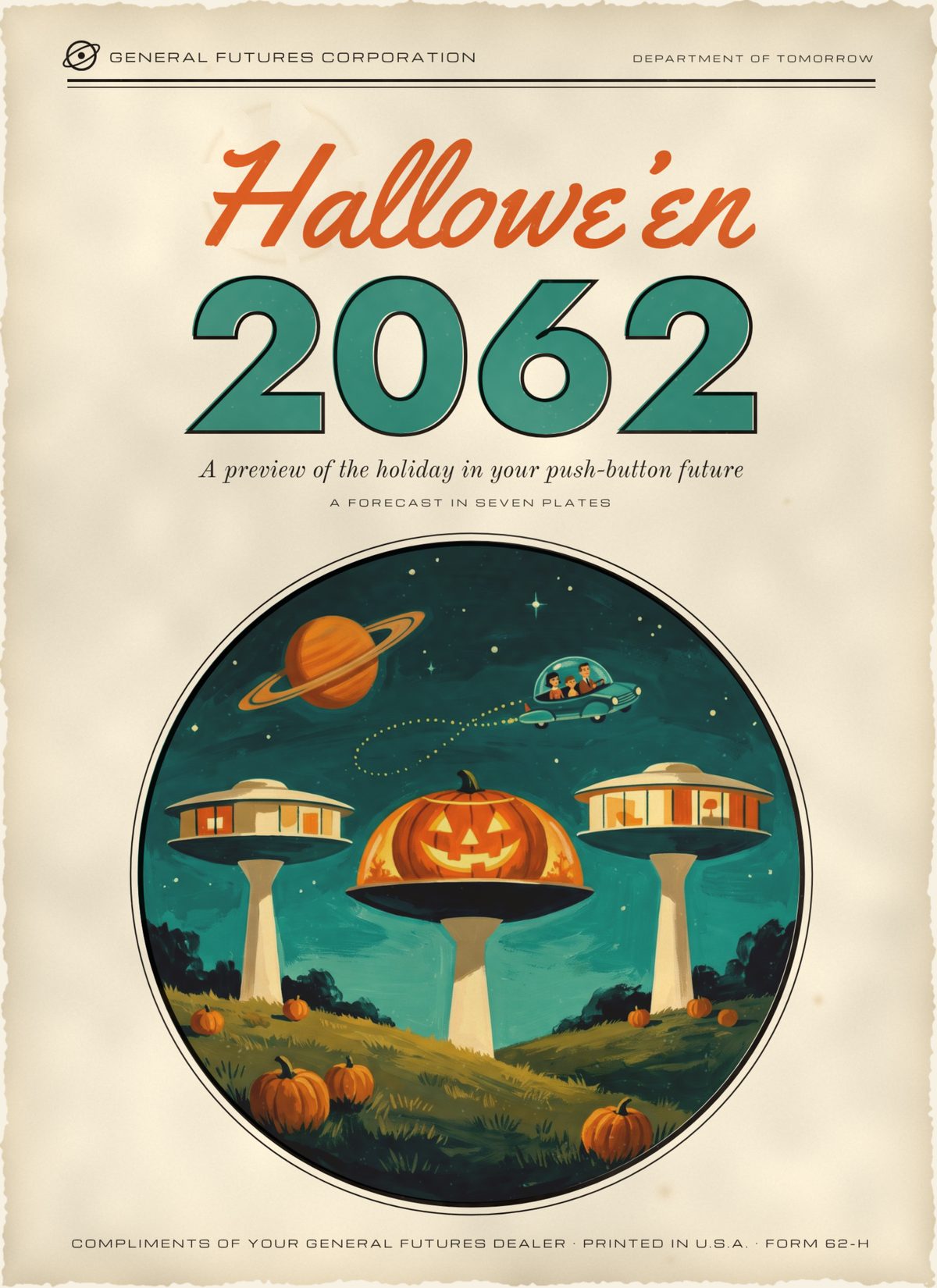
In the fall of 1962 the future arrived in brochures. Appliance makers, carmakers and world’s fairs printed glossy forecasts of the push-button life waiting at the end of the century, and every one of them skipped the night that mattered most to anyone under twelve. So we printed the one they forgot: a deadpan corporate forecast of Hallowe’en a hundred years on, with a robot at the door, a witch on a jet broom and a pumpkin that carves itself. Press the button at the end!
To be clear from the start: the General Futures Corporation never existed, and neither did this brochure. We wrote it, art-directed it and aged it ourselves, in the voice of those earnest forecasts. Everything around it is real, though, and that October turned out stranger than any brochure.
- Apr 21 The Seattle World’s Fair opens under the motto “Living in the Space Age.”
- Aug Bobby “Boris” Pickett releases “Monster Mash.”
- Sep 23 ABC premieres The Jetsons, its first program broadcast in color.
- Oct 20 “Monster Mash” hits No. 1 on the Billboard Hot 100.
- Oct 21 The fair closes after nearly ten million visits.
- Oct 22 President Kennedy tells the nation there are Soviet missiles in Cuba.
- Oct 28 Khrushchev agrees to take them out.
- Oct 31 The kids go trick-or-treating anyway.
The seven plates below are Atomic Daydream originals. How we made them, and our sources for the history, are at the bottom.
Plate 1 The door answers itself
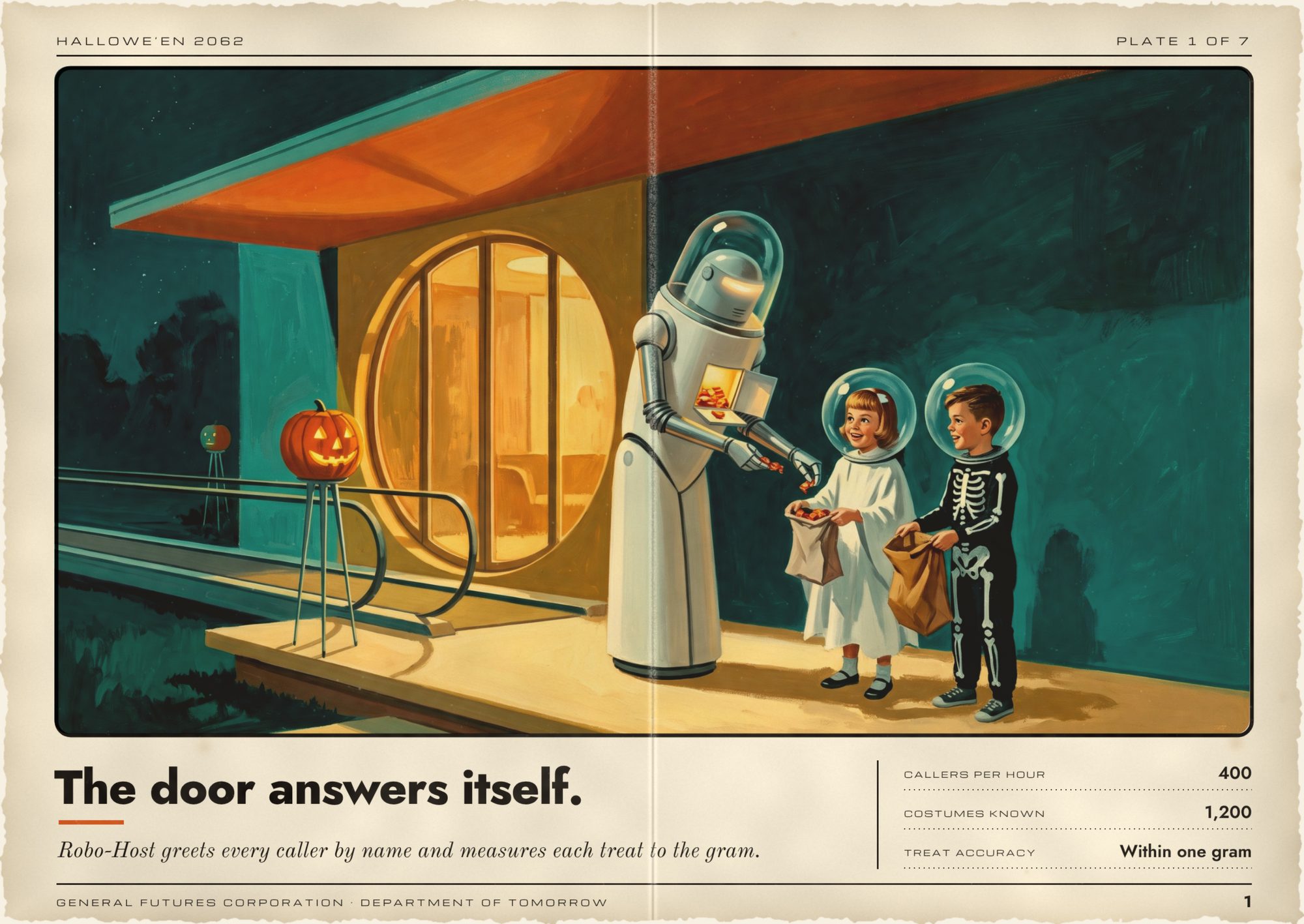
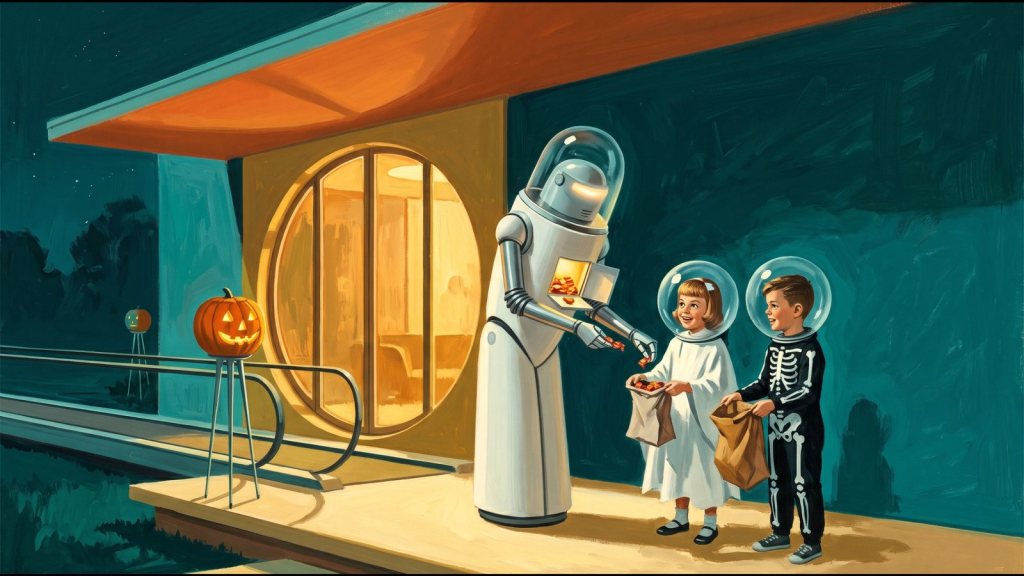
Hallowe’en 2062 begins at the front door, and nobody in the family has to leave the program to answer it. Robo-Host greets every caller by name, admires every costume and measures each treat to the gram from a chilled chest compartment. When supplies run low, it quietly telephones the grocer.
From the brochure
The household robot was the most promised appliance of the Space Age, and the least delivered. The most famous working robot in America in 1962 was Unimate, a one-armed machine lifting hot die castings on a General Motors line in New Jersey, and it never answered a door in its life. Our brochure hands the robot the job every parent would give away in a heartbeat: four hundred knocks in one evening. For the real machines, see our field guide to the robot.
Plate 2 Thirty houses in thirty minutes
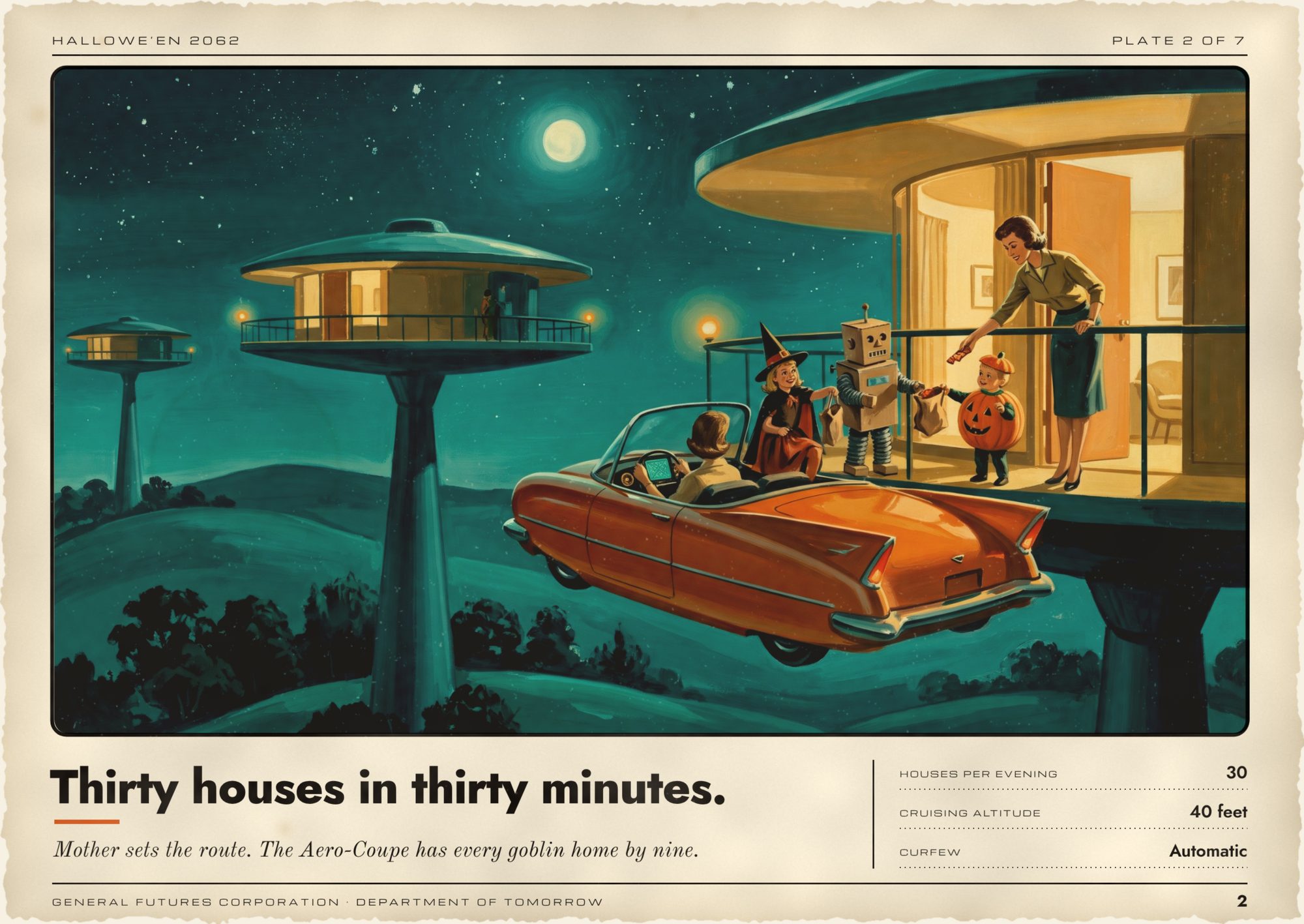
Mother sets the evening’s route on the dashboard, and the family Aero-Coupe does the rest, gliding from porch to porch at a safe and civilized altitude. Landing beacons light every doorstep. At nine o’clock sharp the car brings every goblin home, buckled in and fast asleep.
From the brochure
The flying car was 1962’s favorite promise. Inside the Seattle fair’s main exhibit, a 21-minute tour of the future, visitors rode past commuters in gyrocopters and high-speed air cars. Look closely at the Aero-Coupe, though, and you’ll spot the tell of every forecast from the era: tail fins. The future always looked a lot like this year’s showroom.
Plate 3 A new costume every hour
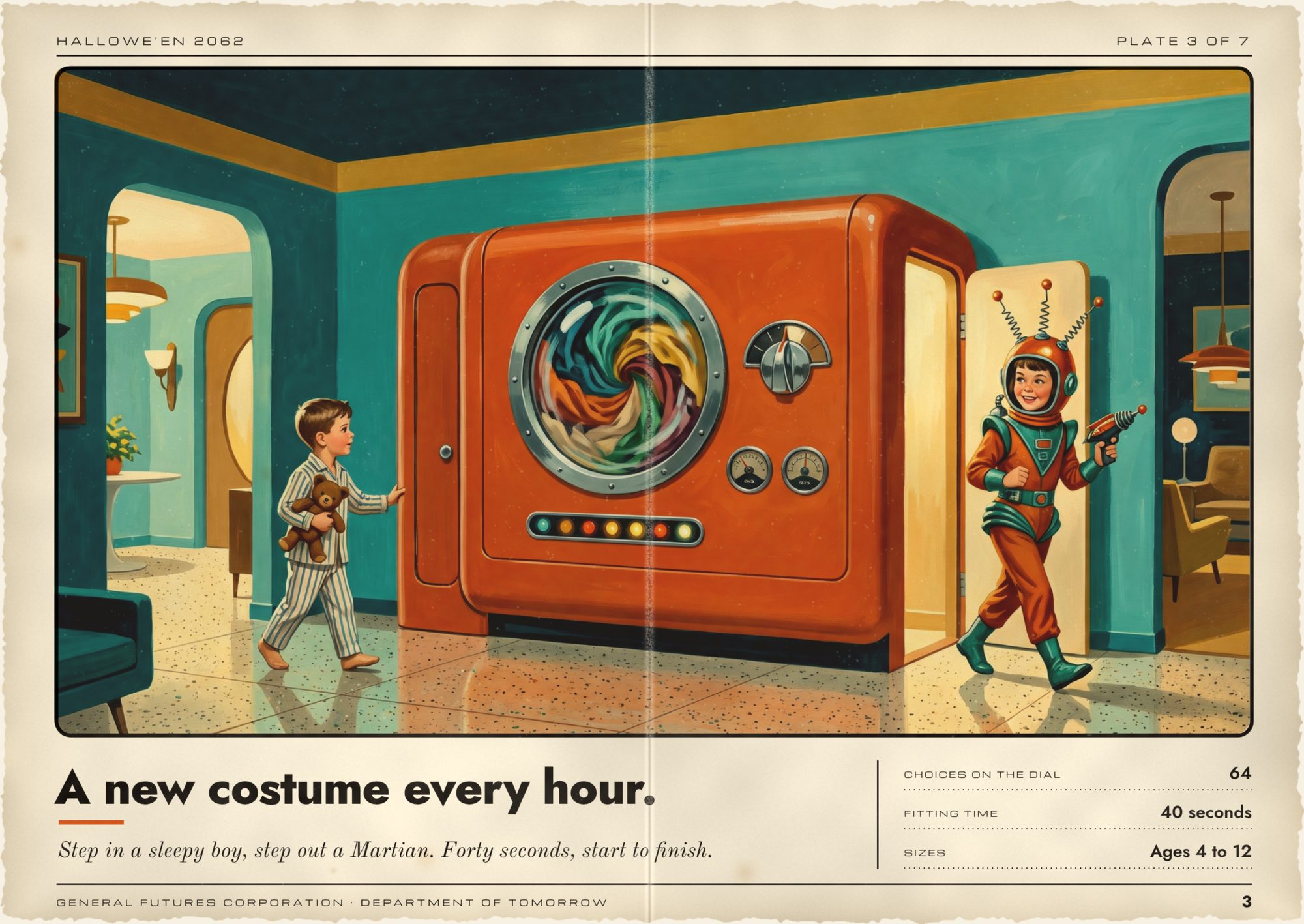
No more sewing until midnight. Step into the Costume-Matic in your pajamas, turn the dial and step out a spaceman, a lighthouse or a reasonably frightening Martian. Each costume is woven fresh in forty seconds and dissolves harmlessly in the morning wash.
From the brochure
In 1962 the real costume came in a box. Ben Cooper of Brooklyn sold most of America’s Halloween costumes in the 1960s, and its “U.S. Astronaut” outfits, a rayon jumpsuit with a mask shaped like a space helmet, came in several versions as the space program grew, some of them glow-in-the-dark. A later one, now in the collection of The Henry Ford, still wears its $1.44 price sticker. That February, John Glenn had orbited the Earth. Nobody wanted to be a Martian. Everybody wanted to be an astronaut!
Plate 4 The witch has a jet now
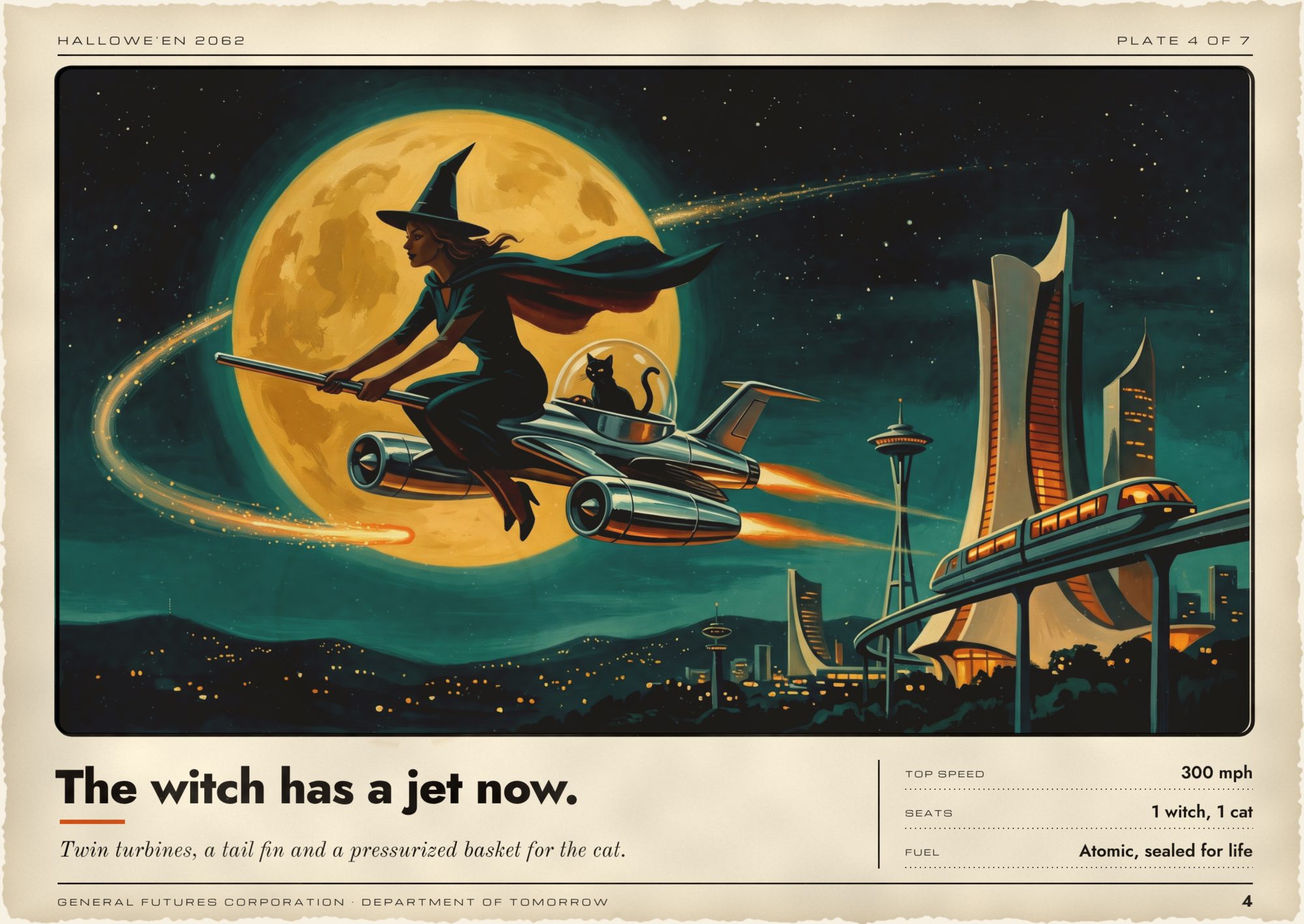
Some traditions are worth keeping, and some are worth improving. The well-equipped witch of 2062 travels by personal jet broom, with twin turbines, a tail fin for stability and a cruising speed of 300 miles an hour. Her cat rides behind her in a pressurized basket.
From the brochure
Look past the witch. That needle with the saucer on top is the Space Needle, built for the 1962 Seattle World’s Fair, and the monorail beside it still runs today. Nearly ten million people came to see the fair’s vision of the twenty-first century. It closed on October 21, ten days before Halloween.
Plate 5 Ghosts on every channel
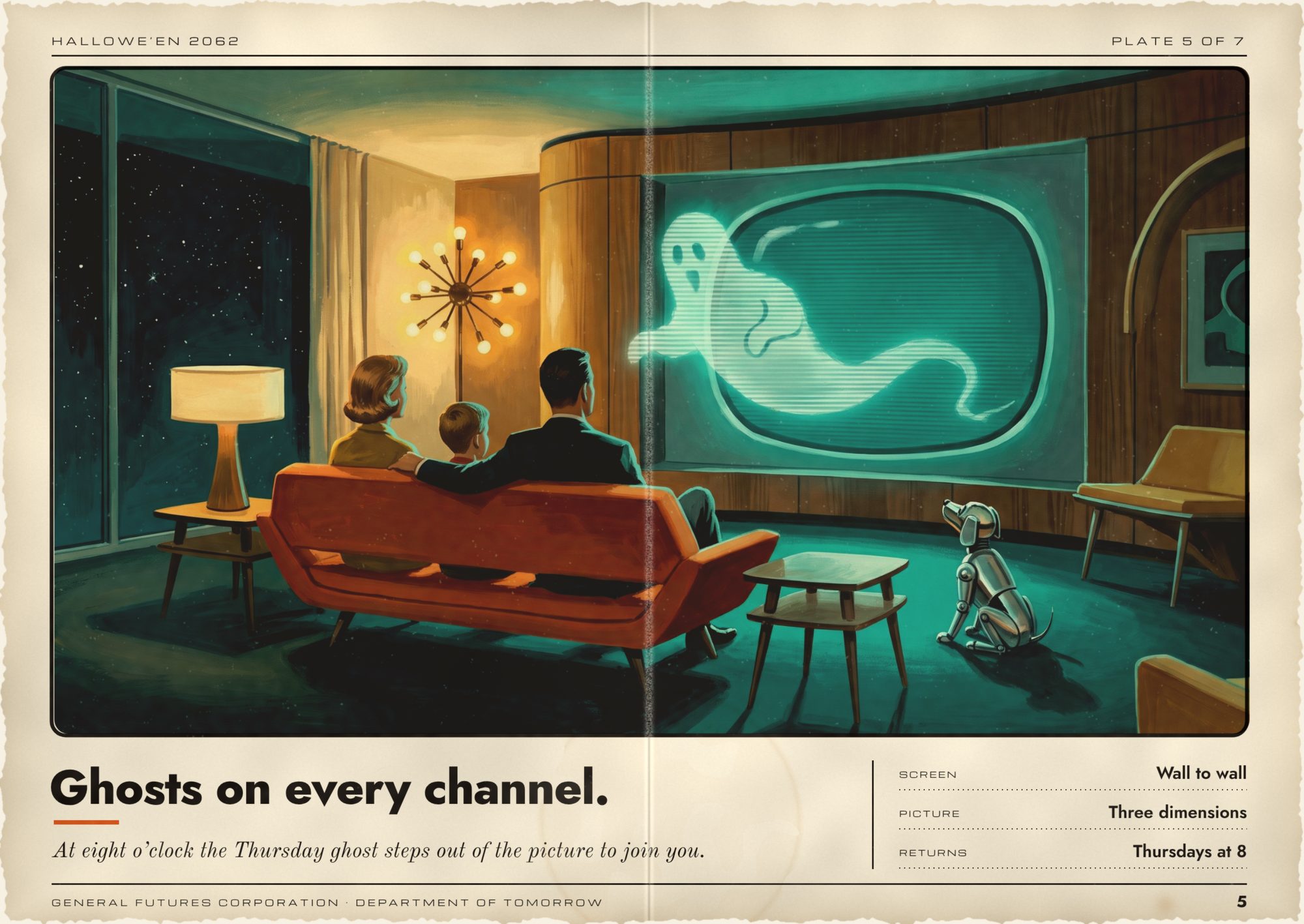
The haunting of tomorrow arrives in living color, on a screen as wide as the wall. The family settles in, and at eight o’clock the Thursday ghost drifts out of the picture and into the room, in three dimensions. It is perfectly safe, and it leaves the moment the set is switched off.
From the brochure
Most American families in 1962 still watched in black and white, so a ghost in living color was a genuine luxury. That September, ABC broadcast its first program in color: The Jetsons, a cartoon about a family living in the sky. A ghost you can switch off sounds like a joke, until you remember what else was on the news that October.
Plate 6 Every shelter, a party
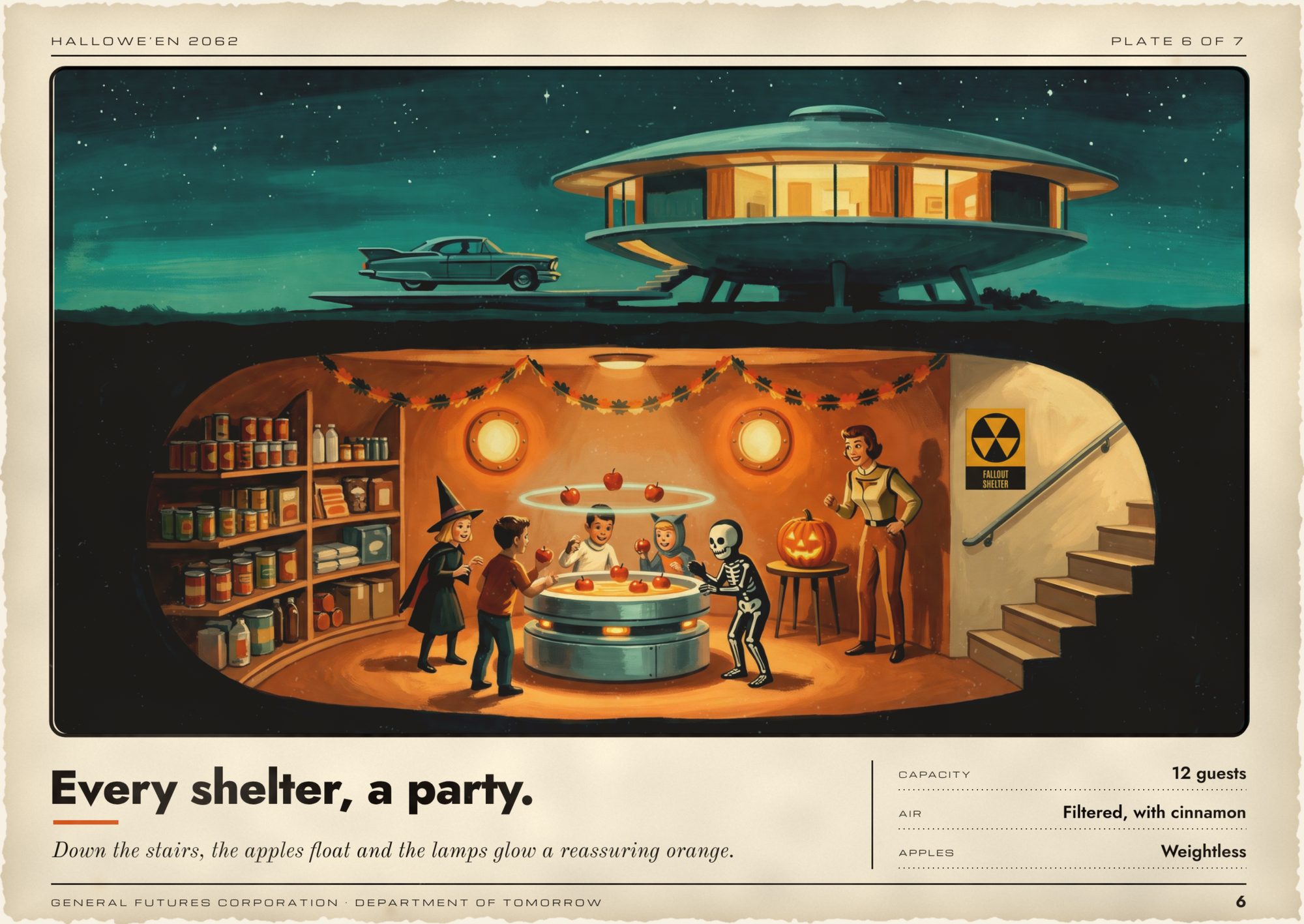
Every home of tomorrow will have its shelter, and in 2062 the shelter is the best room in the house. Down the stairs the children bob for apples that float in mid-air, the lamps glow a reassuring orange and the larder is stocked for a long and happy evening.
From the brochure
This is the one page of the brochure that isn’t really a joke. On October 22, 1962, President Kennedy told the country that Soviet missiles were in Cuba, and for six days families stocked basements and looked up the nearest shelter. On October 28 Khrushchev agreed to remove the missiles, and three days later the kids went out trick-or-treating. In Cecil County, Maryland, police reported a Halloween almost free of mischief that year, and the county decided it needed a bomb shelter of its own.
Plate 7 The pumpkin carves itself
Set the pumpkin on the Autocarver, choose a face from the library of thirty-one and press the button. Three seconds later the lantern is carved, cleaned and lit from within by a cool atomic glow that lasts until Thanksgiving. The seeds are roasted and returned in a separate tray.
From the brochure
Press to carve↻ Put out the lantern
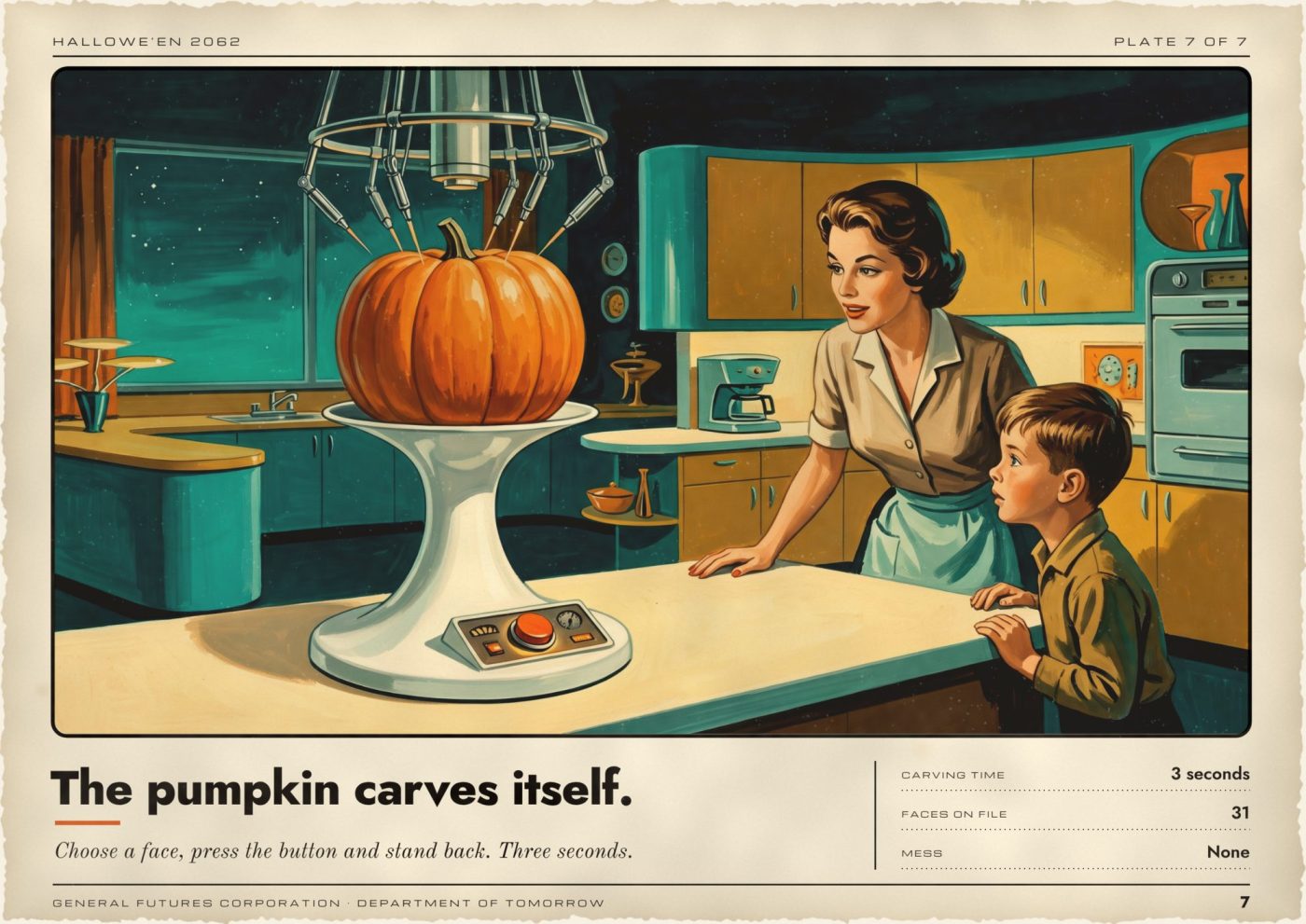
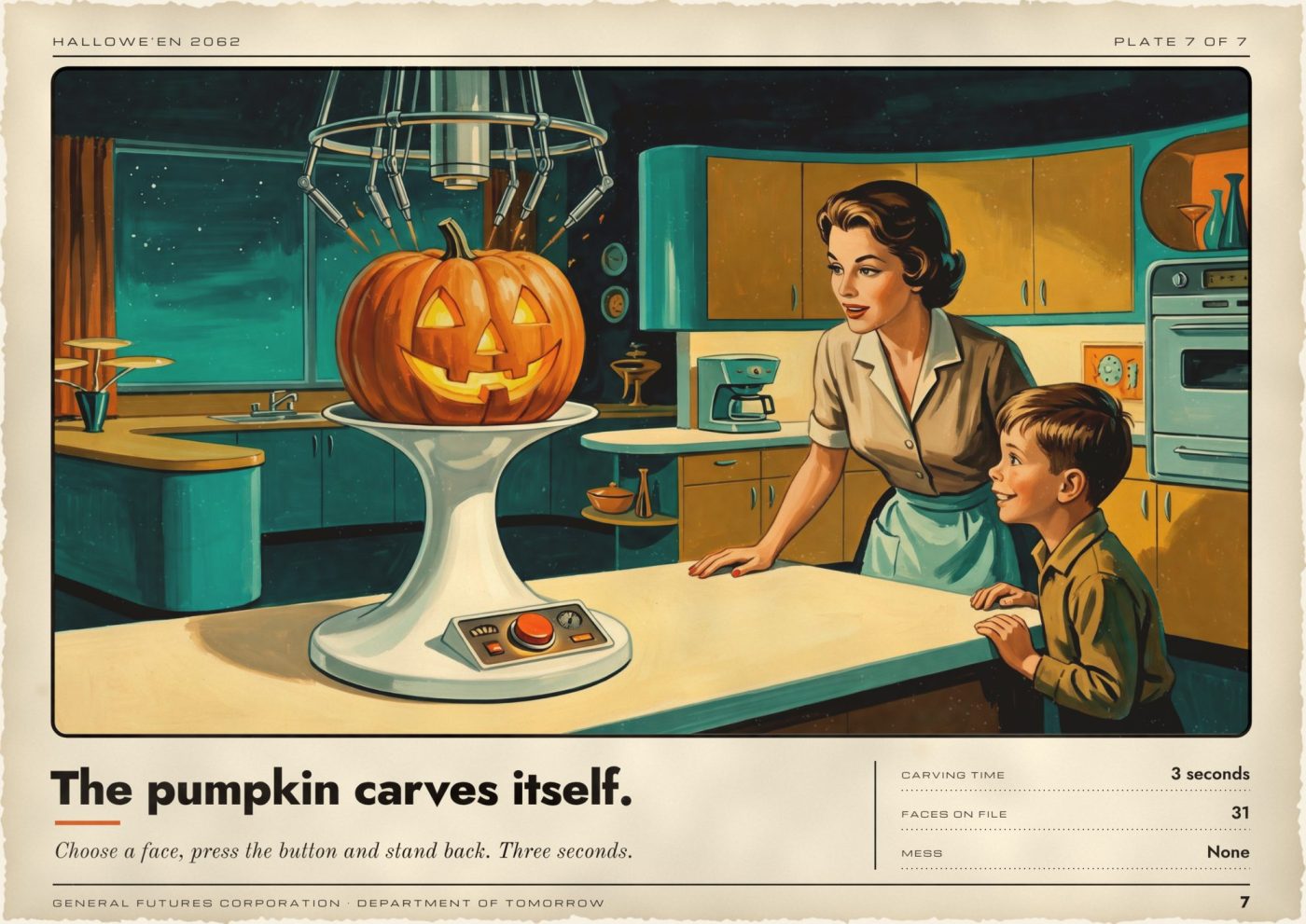
Go on, press it! (Reading this in an email? The Autocarver only works on the website, so you get the pumpkin before and after.)
What the brochure got right
More than you’d think. Wall-sized screens hang in half the living rooms on the street. Costumes turn up on the doorstep the next morning, if not quite in forty seconds. Plenty of front doors now see who’s there and talk to them before anyone gets off the couch. A robot that hands out candy by the gram is still on back order, and nobody we know drives an Aero-Coupe. Yet!
How we made Hallowe’en 2062
We wrote the brochure in the voice of the corporate forecasts of the early 1960s and art-directed its seven paintings, which were made with Google’s Gemini image model. Then we set each page in typefaces of the period, printed it with a black plate that slipped a few pixels out of register, and folded, stained and foxed it until it looked like it had spent sixty years in a kitchen drawer. The shelter sign in plate 6 was relettered to match the real one.
The General Futures Corporation, its Department of Tomorrow, the Aero-Coupe, the Costume-Matic and the Autocarver are all inventions. Any resemblance to a real company is a happy accident.
Sources
- Century 21 Exposition and HistoryLink: The 1962 Seattle World’s Fair
- Monster Mash and The Jetsons
- Slate: how Ben Cooper costumes reinvented Halloween, The Henry Ford: Ben Cooper “Astronaut” costume and The Sixth Floor Museum: Magic-Glo “U.S. Astronaut” costume
- Cecil County History: a Halloween to remember in 1962
More from the archive: the robot, the flying saucer and the ghost. Still have a 1962 forecast in a drawer somewhere? Tell us. We’d love to see what they promised you.


Leave a Reply