The Illustrators · 01
In April 1926 a Luxembourgish immigrant named Hugo Gernsback launched the first magazine devoted entirely to science fiction, and handed the cover to an Austrian draughtsman who had been drawing his radio diagrams for twelve years. Frank R. Paul painted every cover of Amazing Stories for the next three years. When Gernsback lost the magazine and started three more, Paul painted every cover of those too.
Nobody had drawn any of it before. There was no agreed way to draw a spaceship, a robot, a ray gun or a city in the sky, because until then there had been no reason to invent one. Paul invented it at the rate of one painting a month, on newsstand deadlines, for a magazine that cost a quarter.
His name is attached to almost none of the images you have seen.
Why this page is different
Retrofuturism circulates as loose images. Search for any cover below and you will find it reposted on a hundred boards with no artist, no date and no story attached. Often the credit is simply wrong. Three of the covers most confidently credited to Paul online were painted by Leo Morey, by Hans Wessolowski, and, probably, by Hugh Mackay.
So we did the slow version. Every image here is dated, sourced to the issue it appeared on, and matched to the story it illustrates, using the caption the magazine printed on its own contents page. Amazing Stories ran those notes under the heading “Our Cover.” Gernsback’s later titles used “On the Cover This Month.” They are wonderful, they settle arguments, and almost nobody quotes them.
The man
Frank Rudolph Paul was born in Austria on 18 April 1884 and died in Teaneck, New Jersey on 29 June 1963. He came to the United States in his twenties and was working as a commercial artist when Hugo Gernsback hired him, around 1914, to illustrate The Electrical Experimenter. That is the important detail about Paul: he learned to draw the future by drawing machines that actually worked. Cutaways, dynamos, wiring diagrams. It is why his spaceships have rivets, hatches and visible mechanisms, and why his alien cities are drawn in believable perspective by someone who understood how a building stands up.
When Gernsback launched Amazing Stories in April 1926, Paul painted the cover, and then every cover through June 1929. Gernsback lost the magazine in a 1929 bankruptcy, started again within months, and Paul followed him: Science Wonder Stories from June 1929, Air Wonder Stories from July 1929, the two merged into Wonder Stories from June 1930, plus the quarterlies. He was credited on the masthead as Art Director and he painted essentially all of them.
He was the sole Guest of Honour at the first World Science Fiction Convention in 1939. That same autumn he drew the cover of Marvel Comics #1. He was inducted into the Science Fiction Hall of Fame in 2009, forty-six years after his death.
Eleven covers
All eleven are by Paul, all are in the public domain, and each one carries the magazine’s own description of what it shows.
The Moon Pool

…in which Larry, the American-Irishman, proves his true friendship and heroism, when, with automatic poised, he steps between Olaf and The Shining One, just as that sinister thing is about to grasp the Norseman with its shining tentacle.
Amazing Stories, June 1927, “Our Cover”
The Shining One is a creature made of light and sound, which is close to an impossible brief for a painter. Paul answered it with concentric discs and coiling ribbons, and produced one of the first non-humanoid aliens ever printed in colour.
Radio Mates

…is ready to turn the aerial switch, which will cause her to disappear gradually and be transmitted through space by ether wave action, and be reproduced at some distant point, where he expects to follow immediately in like manner.
Amazing Stories, July 1927, “Our Cover”
A matter transmitter, painted in 1927. Note where Paul puts it. Not a laboratory or a launch pad but something like a parlour, with a rug and a lace collar. The future arrives indoors.
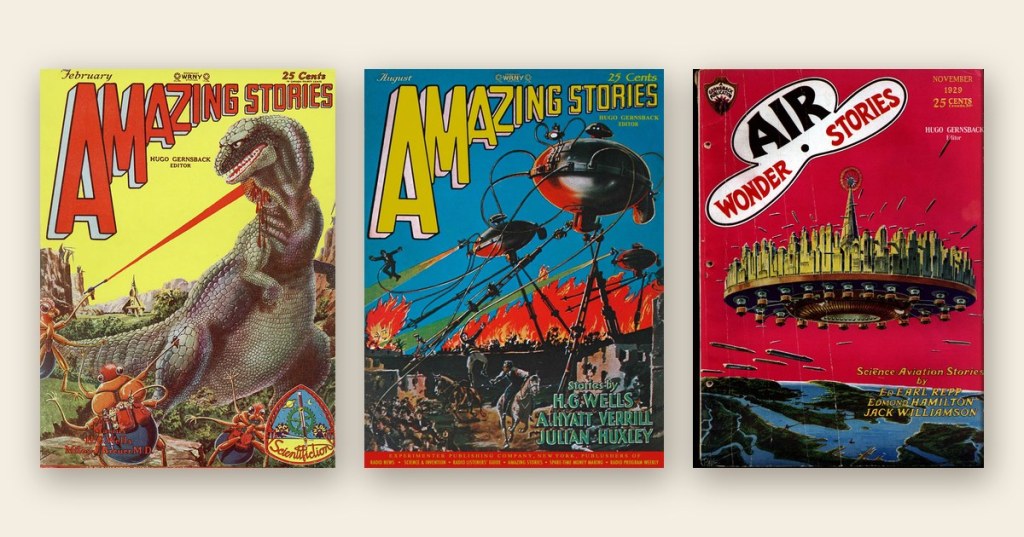
The War of the Worlds

Our Cover this month depicts a scene in “The War of the Worlds,” by H. G. Wells…
Amazing Stories, August 1927, “Our Cover”
Wells had published the novel thirty years earlier. This is one of the first colour paintings anyone made of the fighting machines, and the shape Paul settled on, black and insectile and striding through its own fires, is close to the one most people still see when they hear the word tripod.
The mind’s eye

Our Cover this month represents the subject matter in our new scientifiction contest offering $300.00 in prizes. For details, see Editorial, page 5.
Amazing Stories, April 1928, “Our Cover”
The one cover here that illustrates nothing. Gernsback wanted an emblem for the genre he had just named, and sketched it himself. From his editorial in the same issue: “Not being a draftsman or an artist, I explained my idea to Mr. Paul. The cover picture is the result… The big eye represents the mind’s eye.” Paul turned a publisher’s doodle into a machine the size of a moon.
To the Moon by Proxy

…in which Emil’s ‘proxy,’ in his final test before he is sent on his trip to the moon, meets the lion in combat, on equal grounds. Shorn of every bit of clothing by the fury of the king of beasts, the strange being looks like an armored soldier astride the lion.
Amazing Stories, October 1928, “Our Cover”
A remote-operated body, sent to the moon so that a person does not have to go. We call it telepresence now. In 1928 the way to prove it worked was to make it fight a lion.
The Death of the Moon

…in which the scientists of the moon, who had that day arrived on the planet Earth, are shown fleeing from the jaws of the enraged Tyrannosaurus Rex, the planet’s first inhabitants.
Amazing Stories, February 1929, “Our Cover”
Read that again. The insects are the scientists. We are the monsters. And the red beam comes from a ray gun in a lunar hand, not from the animal’s mouth. Nearly every reposting of this image online has the picture backwards.
Islands in the Air

Our own artist, F. R. Paul, has cleverly portrayed in his inimitable style what one of these future aerial islands will look like… They will be used not only for the regulation of air traffic, but for making emergency stops and to allow passengers to change from local to express lines without ever descending to the surface of the earth.
Air Wonder Stories, July 1929, “On the Cover”
The debut issue. What Paul has drawn is an airport, floating, with a transfer concourse. He is not inventing a fantasy so much as extending a timetable.
Cities in the Air

Here we see the future air city of New York suspended high in the air kept aloft by the cosmic rays and made mobile by the mysterious propeller tubes. The city can rise above storms and, if necessary, above clouds to escape rains and snow. In the center we see the electrostatic tower which gathers the energy for the city’s operation.
Air Wonder Stories, November 1929, “On the Cover This Month”
New York, airborne and steerable. The detail that marks it as a Gernsback production is the justification. The city does not fly to conquer anything or to flee anything. It flies to get above the weather.
The Flying Buzz-Saw

…a flying buzz-saw of the North American Federation (from the story by that name of Harold McKay), ripping through an enemy plane as cleanly as a knife cuts through cheese. In the background another enemy plane is plunging to earth after having been caught by the devastating buzz-saw.
Air Wonder Stories, April 1930, “On the Cover This Month”
There is no softening this one. It is a circular saw the size of a house, it has been given an air force, and the magazine describes its effect using cheese.
The Onslaught from Venus

…the gigantic digging machines of the Venus People in operation, while in the background, one of their heat machines is turning out molten lava made from rock and earth, and which later will be used to make building blocks for these invaders. As observed the digging machines with almost human accuracy carry the lava away.
Science Wonder Stories, September 1929, “On the Cover”
An invasion drawn as a construction site. Nothing in this picture is shooting at anybody. The Venusians have landed, and the first thing they are doing is pouring foundations.
Into the Subconscious

Here we have a graphic as well as vivid picturization by our inimitable artist Paul, of what happens when scientists of the future will make it possible for us to get a sort of television picturization of our sub-conscious memories.
Science Wonder Stories, October 1929, “On the Cover”
The brass domes are not helmets and there is nobody inside them. Each has a television screen set into the front, and the left one is showing a dinosaur. It is a painting of a memory being broadcast, made in 1929, when television was still an experiment with an audience you could count.
Where the record is uncertain
A reference that hides its doubts is worth less than one that shows them, so here are ours.
- His birthplace. The Science Fiction Encyclopedia says Vienna. Researchers working from immigration and census records say Radkersburg, in what was then Austria-Hungary. We say Austria and leave it there.
- His training. One tradition has him studying art in Vienna and Paris and architecture in London. Another, built from documents, finds no formal art schooling at all, some weekend classes in San Francisco around 1910, and stretches working as a waiter. Both are in print. Neither is settled.
- When he emigrated. Sources say 1906, or 1908 with arrival in California in 1909.
- How many Amazing covers. Michael Ashley counts 37. Frank Wu’s checklist counts 38 and notes that September 1928 was Paul redrawing a reader’s contest-winning design rather than originating it. Counting the months from April 1926 to June 1929 gives 39. Take the range and the date span as reliable, and the exact figure as open.
- What is not his. No Amazing Stories cover after June 1929, until he returned for the 35th anniversary issue in April 1961. The Summer 1929 Amazing Stories Quarterly is unsigned and often misattributed to him; Bleiler suggests Hugh Mackay. The November 1932 Wonder Stories is a printed dot pattern, not a painting.
Rights, and where these scans came from
Every cover here was published in the United States before 1931 and is in the public domain, on two independent grounds: the copyright term for pre-1978 published work has expired, and separately, no issue of Amazing Stories was copyright-renewed before 1954. The scans are from the Internet Archive’s Pulp Magazine Archive, which is why you can read the contents pages we quote.
Paul is credited on every image on this page because that is the entire point of it, not because anyone requires us to.
Sources
- Contents-page cover notes read directly from issue scans at the Internet Archive Pulp Magazine Archive
- The Science Fiction Encyclopedia: Frank R. Paul
- David Saunders, Pulp Artists: Frank R. Paul
- Frank Wu’s Frank R. Paul cover checklist, after Michael Ashley, The History of the Science Fiction Magazine
- Galactic Central: Wonder Stories issue checklist
- The Online Books Page: Amazing Stories copyright renewal record
Spotted an error, or know an artist who belongs in this index? Tell us. This is meant to be corrected.


Leave a Reply