From the Archive · Revisited · The Atomic Bomb Ring
In 1947, a kid with fifteen cents and an empty cereal box could mail away for a ring with real radioactive material inside it. Not glow-in-the-dark paint. Not a toy version of the idea. An actual scientific instrument, loaded with polonium, that let you sit in a dark closet and watch atoms fire off sparks an inch from your eye. It was sold by Kix cereal, it was shaped like an atomic bomb, and the instructions called it “perfectly safe.”
We wrote about this ring back in July 2025, and it is still one of the strangest objects in the whole atomic age. So we pulled it out of the drawer for a second look, with better pictures, a proper timeline, and one correction we owe you.
- 1903 William Crookes shows the Royal Society his spinthariscope, a little tube for watching single atoms flash.
- July 1946 The Baker test at Bikini Atoll puts the mushroom cloud on every front page in America.
- Early 1947 Kix ads promise kids they can “see genuine atoms split to smithereens.”
- 15¢ The price, plus a Kix box top.
- 1953 President Eisenhower gives his “Atoms for Peace” speech, nearly seven years after the ring.
- Today The polonium is long spent, the rings have gone dark, and one sits in a radiation museum in Tennessee.
1946 The year everybody wanted an atom
To understand the ring, you have to remember how new all this was. A year and a half before the ads ran, almost nobody had heard the phrase “atomic bomb.” Then came Hiroshima and Nagasaki, and in the summer of 1946 the Navy staged two tests at Bikini Atoll in front of cameras, reporters and a fleet of empty warships.

This is the picture that was in the air when the Kix ads were written. Terrifying, yes. But also, to a lot of Americans in 1946, thrilling. The atom was the biggest thing that had ever happened, and advertisers wanted a piece of it. Within months there were atomic cocktails, atomic hairdos and atomic sales. General Mills went one better and put a real atom in the box.
1947 The pitch
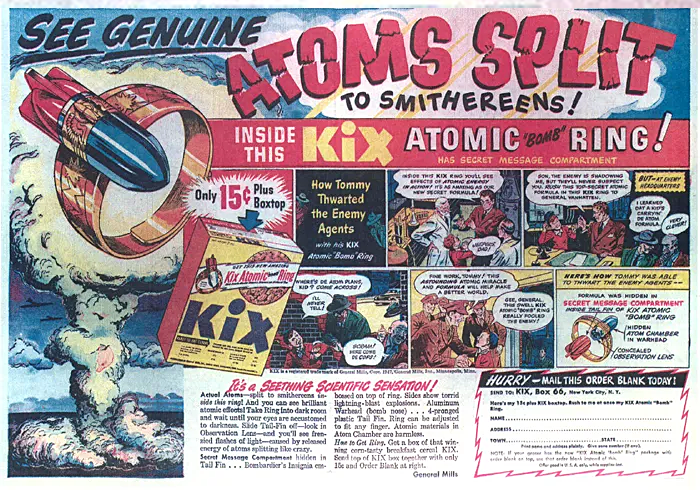
The offer ran as comic-strip ads in newspapers and comic books in early 1947. Look at how hard they sell it. There are no tiny disclaimers here. The radioactivity is the whole point.
See genuine atoms split to smithereens!
Kix advertisement, 1947
The copywriters were having the time of their lives. The ring was “a seething scientific sensation!” One of the cartoon kids, peering into it in the dark, gets the best line of the whole campaign: “Jeepers! Lookit’ those atoms kick the bucket!”
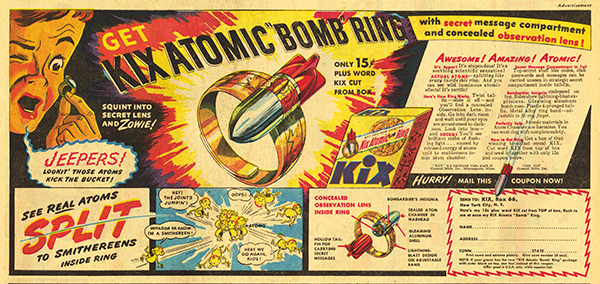
A slightly different deal on this one: fifteen cents plus the word “Kix” cut from the box. Either way, you mailed off your coins and waited by the mailbox for your atom to arrive.
15¢ What came in the mail
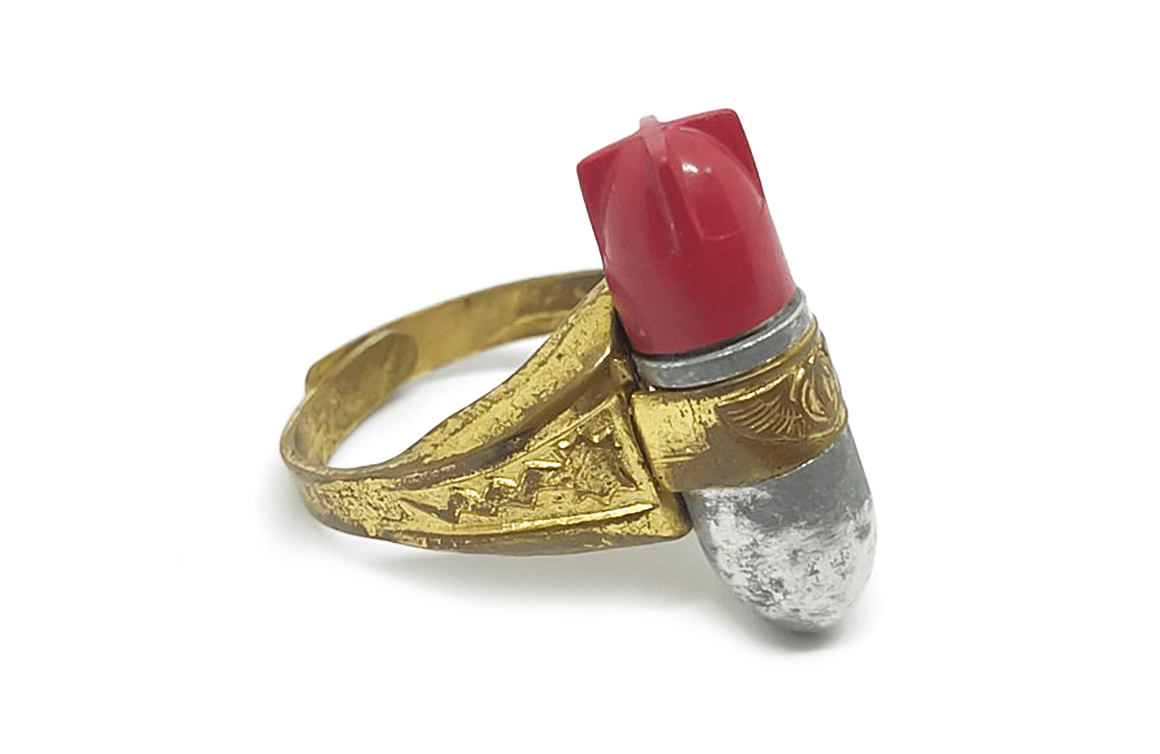
Here it is. An adjustable gold-tone band with lightning blasts stamped on the sides, an aluminum warhead on top, and a red plastic tail fin. The tail fin pulled off, and inside was a hollow chamber for secret messages. That would have been plenty for most cereal premiums. This one had more.
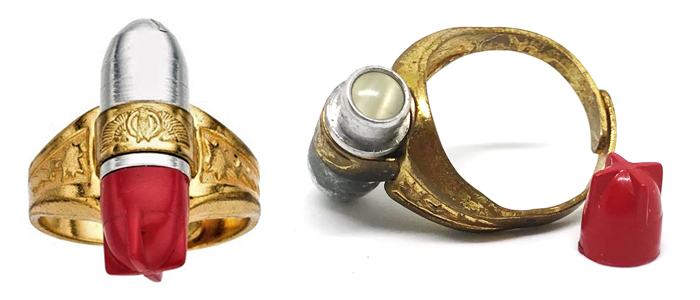
At the tip of the warhead was a tiny plastic lens. Behind it, a screen coated with zinc sulfide. And just in front of that screen, a speck of polonium-210, one of the most radioactive substances there is.
1903 How a ring shows you an atom
The gadget inside the ring was not invented by General Mills. It is called a spinthariscope, from the Greek for “spark,” and the British chemist William Crookes came up with it in 1903. He found that when radioactive material sits next to a zinc sulfide screen, the screen does not glow evenly. It twinkles. Each pinpoint flash is a single alpha particle, thrown out of a single decaying atom, hitting the screen. Crookes presented it to the Royal Society that May, and for a while a spinthariscope was the fashionable thing to have on a Victorian parlor table.
Forty-four years later the same trick was riding on a kid’s finger. You took the ring into a dark room, waited a few minutes for your eyes to adjust, and looked through the lens. There they were, tiny sparks winking on and off, each one the end of an atom.
Perfectly safe.
The ring’s instructions, 1947
So was it? Mostly, and somewhat by luck. Alpha particles are big and slow. A sheet of paper stops them, and so does the outer layer of your skin, so the ring on your finger was not doing you much harm. The danger with polonium is getting it inside you, by swallowing or breathing it. A sealed ring was fine. A ring that a curious nine-year-old pried open with a butter knife was a different story. Nobody seems to have thought very hard about that in 1947.
Today The sparks have gone out
If you find one of these rings at an estate sale, and people do, don’t expect a show. Polonium-210 has a half-life of about 140 days. Half of it is gone in under five months, and after a couple of years there is almost nothing left. Every Kix ring went dark a very long time ago. Today they are just handsome little bombs with a famous past, and collectors pay real money for them.
You will often see it listed as the “Lone Ranger Atomic Bomb Ring,” because General Mills sponsored The Lone Ranger on the radio. Oak Ridge Associated Universities, which keeps one in its museum of radiation in Tennessee, points out that this is a slightly odd pairing. A masked cowboy of the old West, selling atom bombs. That was 1947.
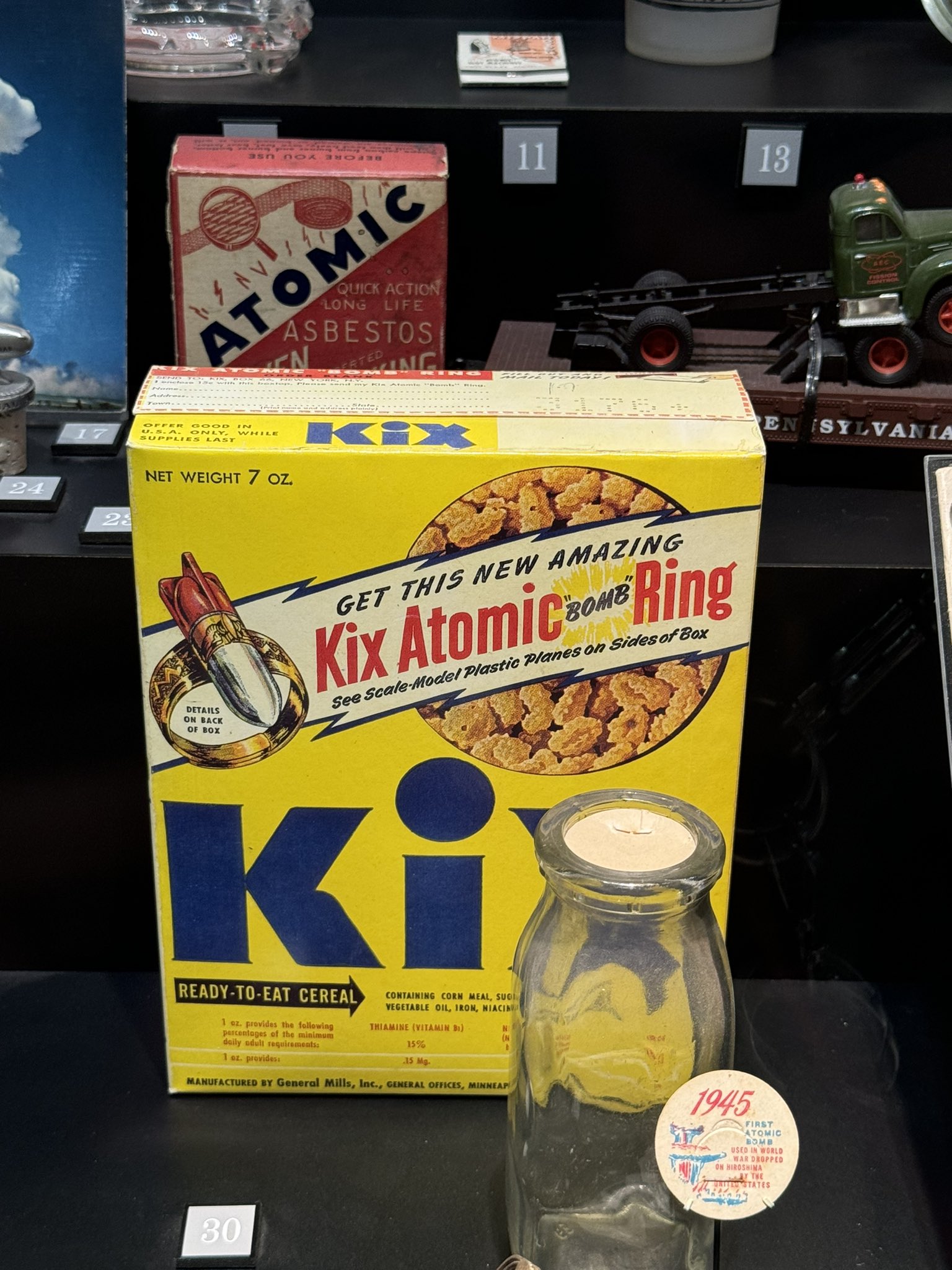
The cereal box itself, now behind glass. Kix is still on the shelves. The premiums are a little tamer.
What we got wrong the first time
Our 2025 post linked the ring to the “Atoms for Peace” era. That doesn’t work. Eisenhower’s Atoms for Peace speech was in December 1953, nearly seven years after the ring. The ring belongs to an earlier, wilder moment, right after the war, when the atom was a new toy and nobody had yet worked out what the polite way to talk about it would be. We have fixed it here, and we are sorry for the time travel.
And one note on the ad copy, which was wrong in a more fun way. No atoms were “split to smithereens” inside the ring. Splitting atoms is fission, the thing that happens in a bomb. What the ring showed was radioactive decay, atoms quietly falling apart on their own. That is less exciting to put in a comic strip, but it is the reason the ring didn’t take the kitchen with it.
Where the record is uncertain
- How many were made. We have not found a reliable number. Claims run into the hundreds of thousands, but we could not trace any of them to General Mills.
- How long it was offered. The Kix ads ran in early 1947. Oak Ridge dates its ring from 1947 to the early 1950s, so the ring may have stayed in circulation well after the first ads.
- How much polonium. The amount in each ring was tiny, but we have not found a contemporary figure we trust.
- The Lone Ranger name. The ring is widely sold today as a Lone Ranger premium. The 1947 ads we have seen sell it under Kix and do not feature him.
Rights, and where these images came from
The Crossroads Baker photograph is a work of the U.S. government and is in the public domain. The two 1947 Kix advertisements are reproduced here for history and commentary. The photograph of the ring comes via Todd Coopee of Toy Tales, the photograph of the ring taken apart via Global Toy News, and the museum photograph via @auderdy. Thank you to all three. If one of these is yours and you would like a different credit, or would like it taken down, tell us.
Sources
- Lone Ranger Atom Bomb Ring Spinthariscope, ORAU Museum of Radiation and Radioactivity
- Atomic “Bomb” Ring from Kix, Todd Coopee, Toy Tales
- Spinthariscope and Polonium-210
- Operation Crossroads and Atoms for Peace
More from the archive: the Atomic Monster, and how the bomb woke a bestiary, and our original 2025 post on the ring. Did you, or someone in your family, send away for one? Tell us. We would love to know if anyone ever saw the sparks.


Leave a Reply