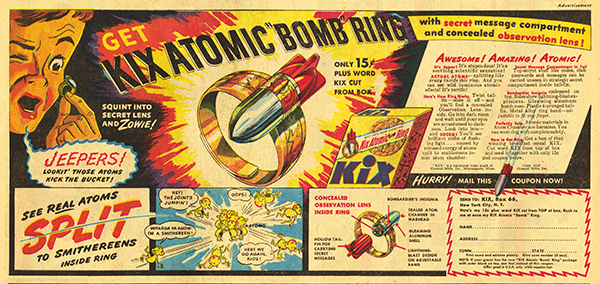
“See Genuine Atoms Split to Smithereens!”
This wild, preposterous, and ill-conceived cereal toy is no joke, but the history behind it feels like the plot of an elaborate movie.
Was this the ultimate cereal box toy? Or a potential disaster? Read on.

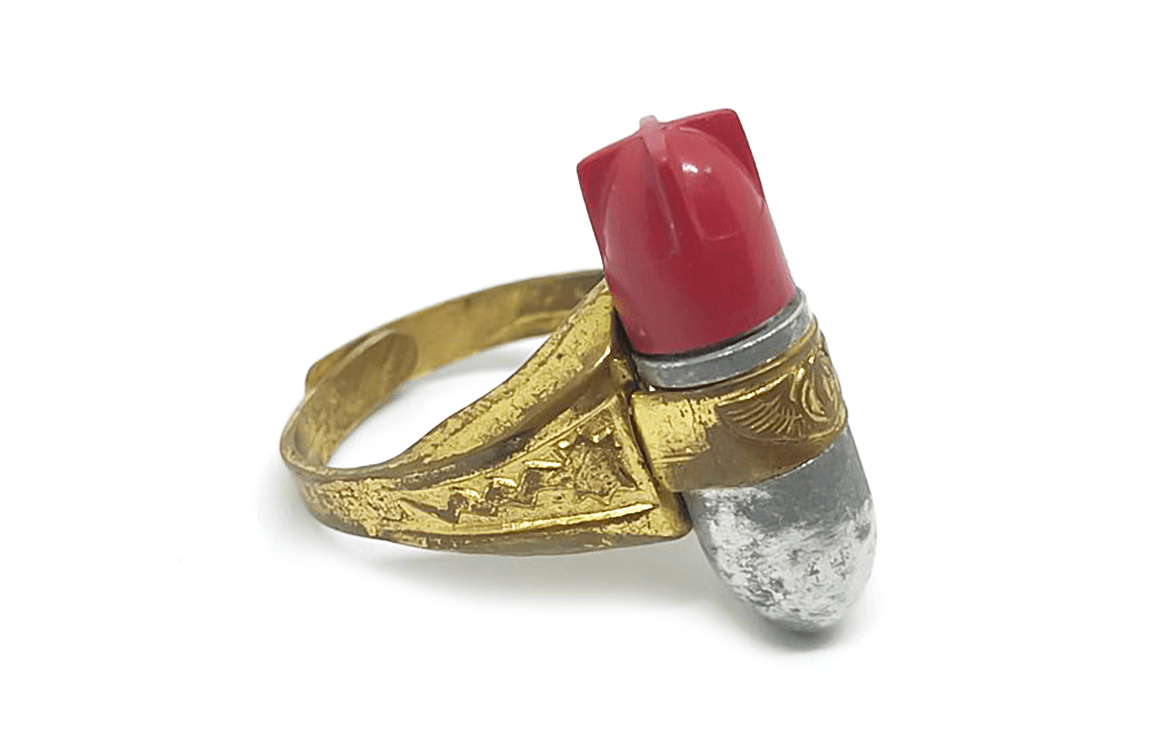
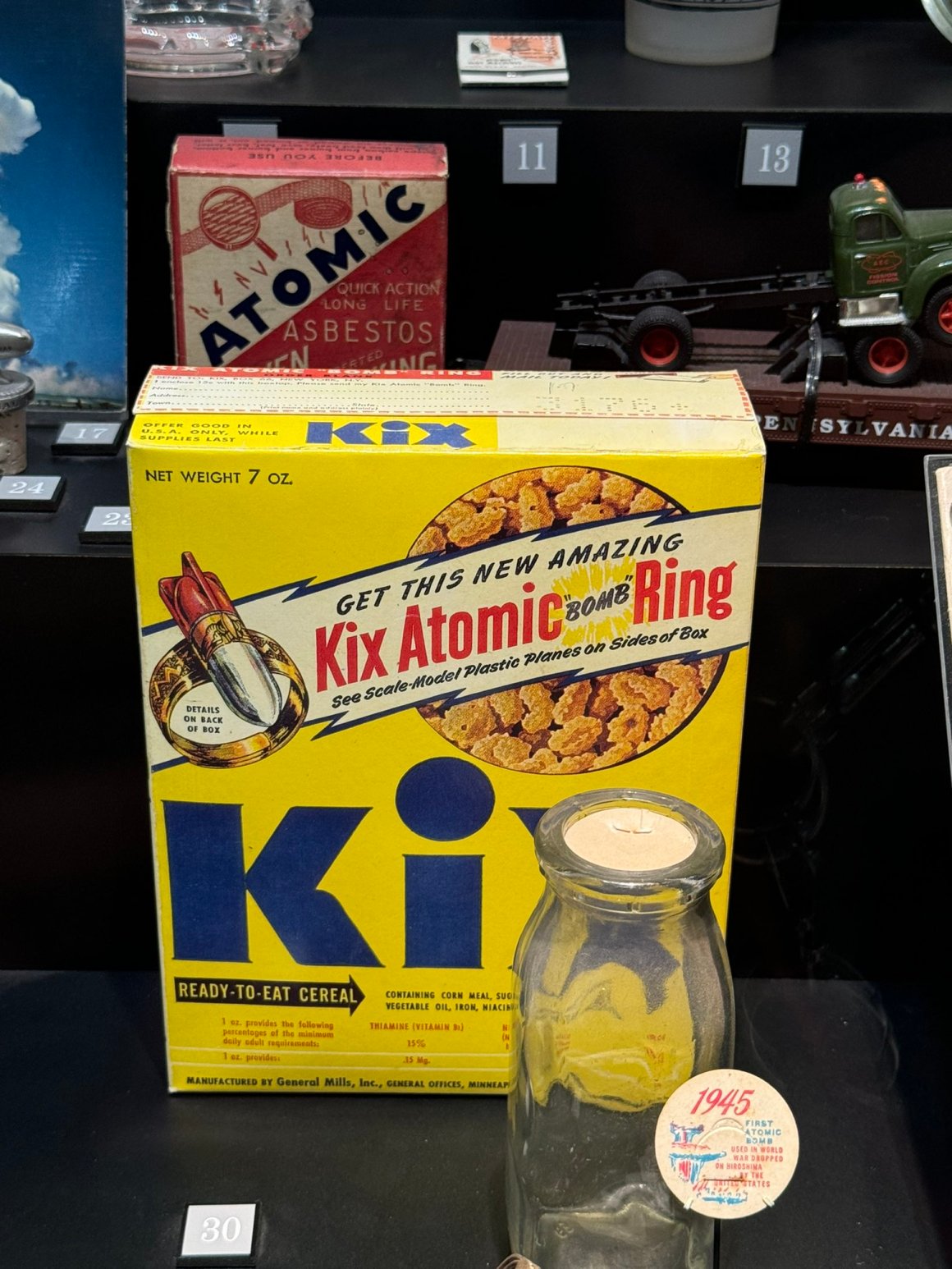
In 1947, the fine folks at General Mills (makers of KiX cereal) conjured up a bizarre promotional keep‑sake. It was called the Lone Ranger “Atomic Bomb” ring.
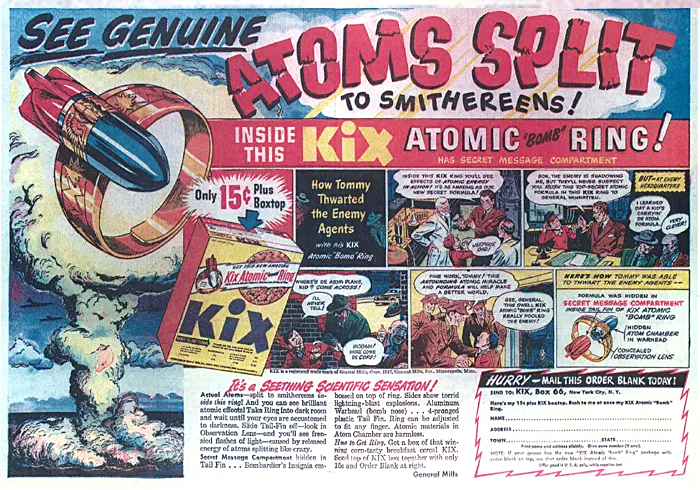
For the princely sum of 15¢ and a cereal box-top, kids could get their hands on this shiny gold-toned ring topped with a red-plastic bomb-shaped shard that served a secret purpose.
🚀 What made it so wild?
- Peek through the bomb cap in a dark room and—presto!—you’d see scintillating flashes of light. This wasn’t magic; it was a spinthariscope, a genuine atomic toy.
- Inside lay a tiny grain of Polonium‑210, an alpha-emitting radioisotope with about a 140-day half‑life. Its alpha particles hit a zinc sulfide screen, lighting it up for a short-lived but authentic “atomic” show.
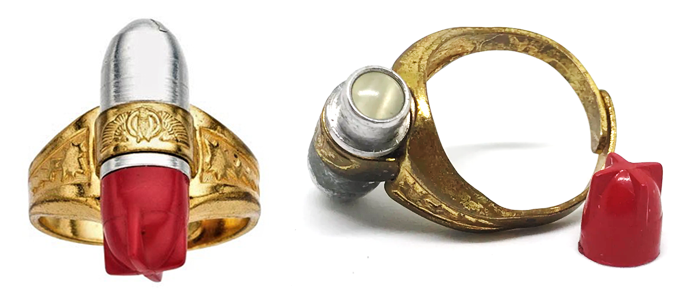
A curious mix of fear, fascination, and frontier
It was a product of post-war “Atoms for Peace” optimism. At the time, atomic power wasn’t just destructive, it was seemingly miraculous.
The ring tied that heady promise to pop culture with a Lone Ranger tie-in—seen as scientific wonder and a heroic symbol.
“JEEPERS! Lookit’ those atoms kick the bucket!”
Safety and legacy ☢️
Ads at the time reassured parents: the atomic elements were “harmless”.
And technically, external alpha radiation from Polonium‑210 is harmless—the particles can’t even penetrate skin. Reddit points out:
“outside the body, Polonium‑210 is fairly harmless…it can’t even penetrate…dead skin.”
But ingestion would be dangerous—remembering Litvinenko’s murder—it’s how Po‑210 truly kills ().
Its short half-life means any surviving rings no longer glow; the radioactive spark is long gone.
And today, such a radioactive toy would be unthinkable, though it remains a quirks-rich emblem of mid-century atomic bravado.
In today’s terms:
- Vintage value: Sellers on eBay list them anywhere from approx. CA $480–880
- Collector’s takeaway: Part cowboy toughness, part Cold War science, all collectible oddity.


 Atomic Daydream
Leave a reply to Richard Kurtz Cancel reply